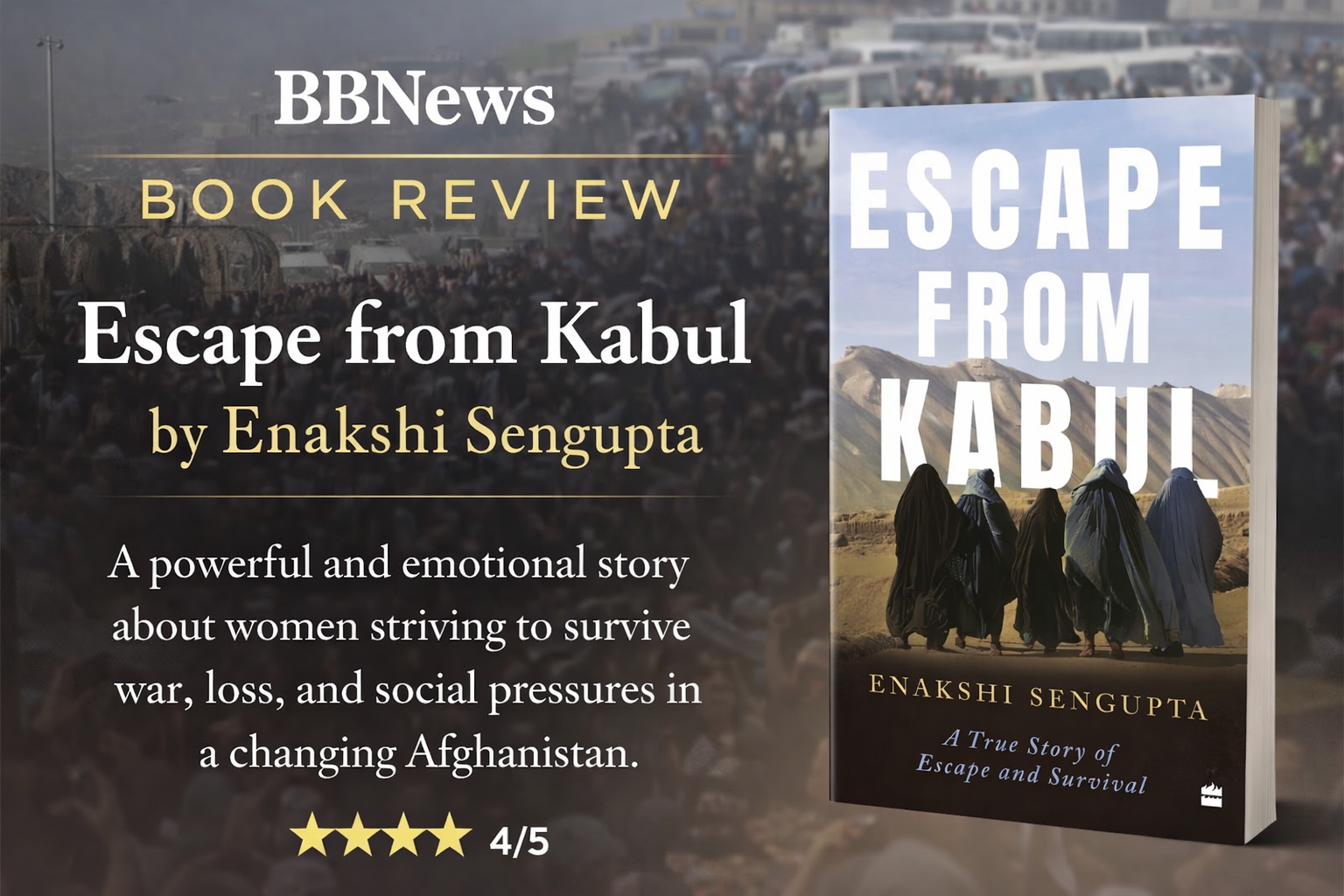
Book Review : Escape from Kabul by Enakshi Sengupta
Escape from Kabul is an emotional and powerful novel about women trying to survive during one of the most uncertain moments in Afghanistan’s recent history. Through simple and direct language, Enakshi Sengupta tells the stories of five strong yet vulnerable women—Dr Cathy, Anjali, Nadia, Fawzia, and Zohra—whose lives change completely after the Taliban take over Kabul.
The political crisis is not just background in this novel. It becomes a turning point. When the Taliban regain control, fear spreads quickly. The university environment changes, security tightens, and the women realise that staying in the country may no longer be safe. What follows is a tense and emotional struggle to leave Afghanistan.
Their attempts to escape are filled with confusion, uncertainty, and danger. Plans keep changing. They depend on drivers, contacts, guards, and embassy officials. At one point, they are moved to a compound for safety. Men and women are ordered to stay separately. There are rumours, threats, and constant anxiety about who can be trusted. The airport scenes are chaotic, with crowds desperate to board flights. Through these moments, the reader feels the fear and helplessness of people trying to escape a collapsing system.
Each woman faces this crisis differently.
Dr Cathy tries to stay calm and take responsibility. She searches for contacts, negotiates, and makes difficult choices. She feels the pressure of protecting the others, even when she herself is afraid.
Anjali, already carrying personal grief, now faces another emotional storm. Being far from home, she struggles with the thought that she might never return safely. Her fear is quiet but intense. She thinks about her past, her husband, and the life she left behind.
Nadia’s situation is even more urgent. If she is forced to stay, she risks being sent back to her abusive husband. For her, leaving the country is not just about political safety—it is about survival. Her panic and breakdowns show how limited her options are.
Fawzia, who has already survived physical injury and emotional abandonment, now fears for her son’s future. She dreams of a safe and stable life for him. The takeover makes her realise how fragile that dream is.
Zohra, caught between cultures, now sees the harsh reality of the country she had once questioned from a distance. Her struggle is not only physical but emotional—she must face the consequences of being in a place that feels both connected and unfamiliar.
Through these characters, the novel shows how war and political change affect women in deeply personal ways. The struggle to leave the country becomes a symbol of a larger struggle—the fight for safety, dignity, and freedom.
Escape from Kabul is not just about escaping a city. It is about escaping fear, violence, and uncertainty. The novel reminds readers that behind every political headline are real people—especially women—trying to survive, protect their families, and hold on to hope