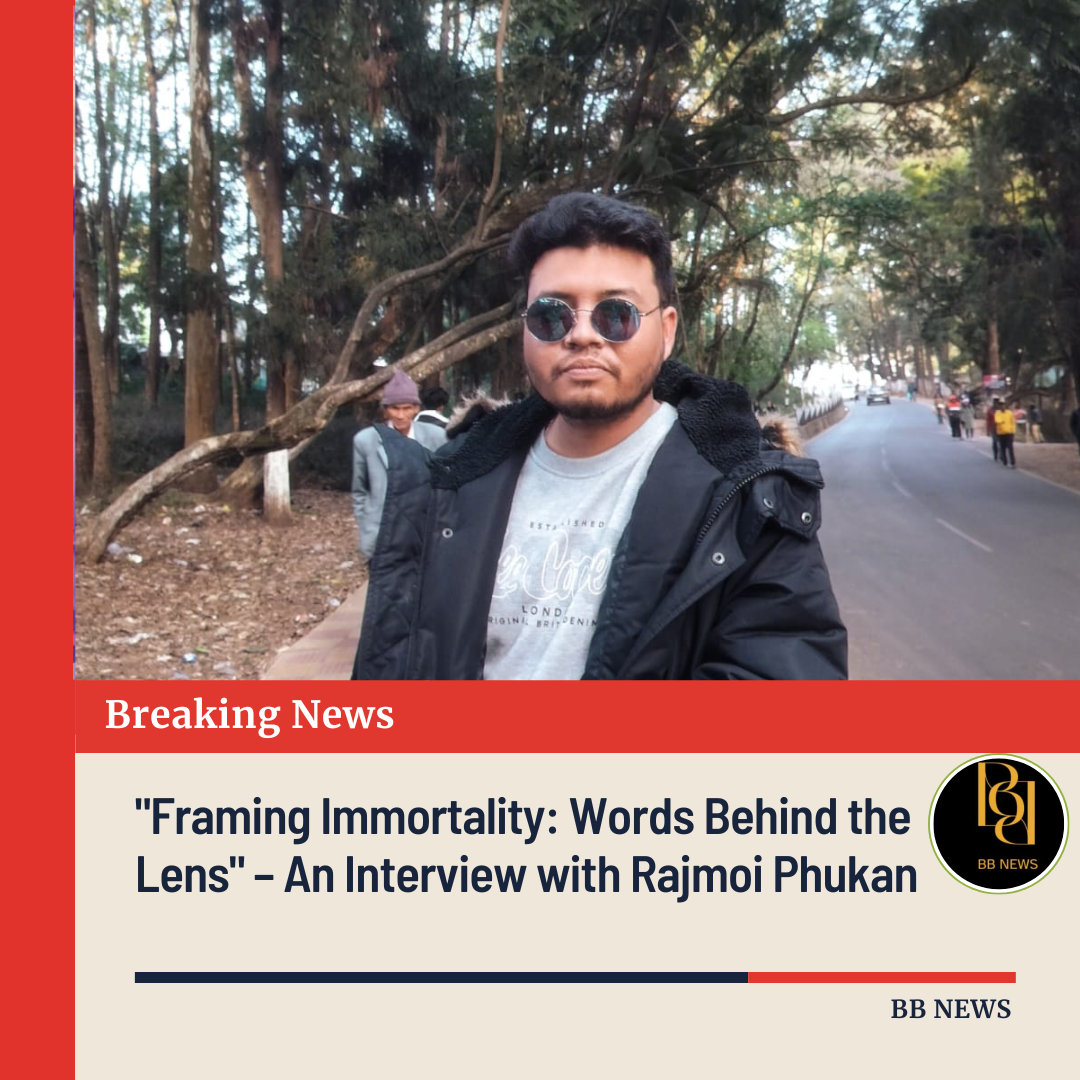
“Framing Immortality: Words Behind the Lens” – An Interview with Rajmoi Phukan
Author of House for My Immortality, Visual Storyteller Through Poetry and Photography
Meet Rajmoi Phukan, a storyteller who paints with both words and visuals. As the author of the thought-provoking book “House for My Immortality”, Rajmoi merges the reflective stillness of photography with the emotional intensity of writing. With a passion for capturing life’s fleeting moments, he explores themes of memory, existence, and timelessness—both on the page and through the lens.
Interview with Rajmoi Phukan
- Your book “House for My Immortality” has such a profound title. What does ‘immortality’ mean to you in the context of your writing?
Answer: For me, immortality is living on with words, long after you are not there, long after you are gone, long after you are not physically present. Obviously, in this fast paced world, no one dares to stop by, let alone read some words, but, I believe, if I made even a single reader: pause, reflect or remember a sweet memory of them, then- I have achieved a tiny part of the motive behind it. The concept of immortality regarding this book, is that, the reader or the lover, goes back to those verses, not every second of their day, but at that time, when the lights are dimmed, when no one’s around, and they fill up their glass with a drink, might be tea no issues, but they are alone, with their thoughts and memories. And if one poem, or even a sentence resonates with them, and they close their eyes and put my book near their heart, that is immortality. Ah, I surely want my book to be held in that way.
- How does your love for photography influence your writing—do you often see stories through images first?
Answer: Not necessarily, now that part is really complicated. My love for photography goes back to when I was a child. I have travelled almost most of India, and during those trips, I used to click photographs. But I delved deeper into that art during college, after a small rejection from a crush of some sort, in my first semester, haha! But yeah, I still remember, during my first year at college, during second semester, it was republic day, when I was involved with the photography club. I was clicking photographs of everyone that day, but no one clicked mine, but there was this lovely soul who offered to click mine as well. Then three years passed by, it was early 2020, when I asked her out to a concert, at our college cultural fest, as we were in the final year. Unluckily I don’t have any photographs of that day, except the band that was performing then. So, I thought of penning that memory in verses. But, boy oh boy, I never came close. But nonetheless, photography is a cherished hobby of mine. And I’m working on it to make it into a compelling storytelling element, just like my poetry. But artificial intelligence is spoiling the essence of these art forms. - Many readers find your work deeply philosophical. What emotions or thoughts were you exploring while writing this book?
Answer: Yes, this book is indeed philosophical. Just like the concept of immortality through words, with memories. It was the pandemic lockdown, when the whole world suddenly came to a halt. I had this sudden change in me, a sudden emotion of longing and search for meaning, as well as a search for a purpose. So I picked my pen and started penning those random thoughts of mine. Approximately seven hundred poems were written since that day, but only these twenty one poems were given a home.
- Can you tell us about a particular photograph you’ve taken that later inspired a poem or piece in your book?
Answer: Well most of the photographs I clicked, especially those clicked during my travel from kempegowda international airport to kochi, inspired the poem “From kempegowda international airport to Cochin” poem in the book. It is a travel monologue with a quiet personal reflection of a sweet memory.
- How do you navigate the creative process—do photography and writing serve different purposes in your life or do they intertwine?
Answer: obviously they do not. They serve the same purpose. The purpose of self expression, the purpose of storytelling.
- What can readers and viewers expect from you next? Are there any new projects, exhibitions, or books on the horizon?
Answer: Yes! Indeed, there is. I am working on my next upcoming project in a span of three years, if everything works out well. Since there were no illustrations in this book, my next project will also have a visual storytelling element.