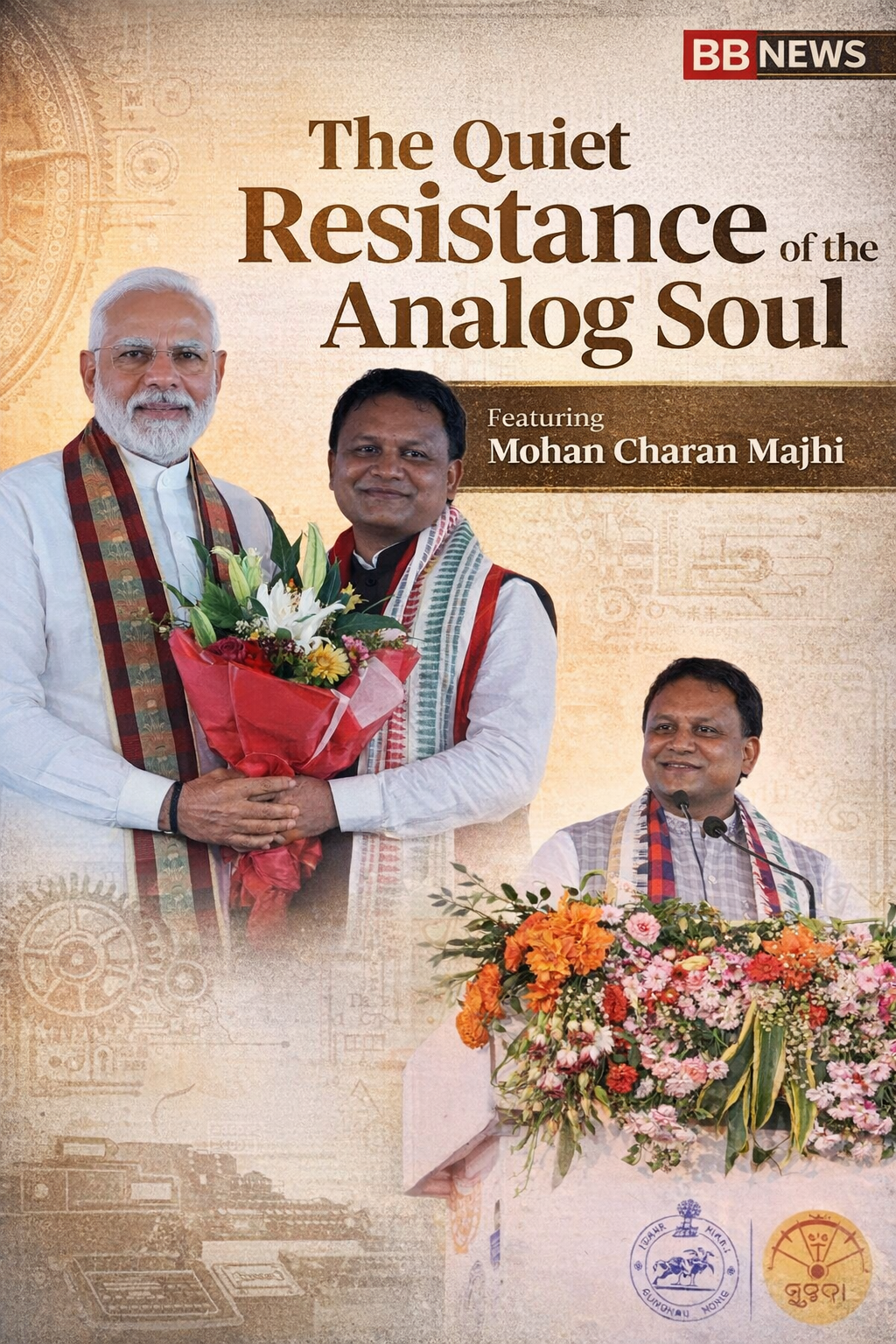
The Quiet Resistance of the Analog Soul: Featuring Mohan Charan Majhi
In an era where our worth is often measured by the speed of our fiber-optic connections and the density of our digital calendars, there is a growing, quiet rebellion taking place. It isn’t a loud protest or a movement with a manifesto; rather, it’s a subtle shift in how we choose to spend our most precious resource: time. We have spent the last two decades optimizing every second of our lives for efficiency, yet many of us find ourselves feeling more exhausted than productive.
The “always-on” culture was sold to us as a form of freedom. We were told that being able to work from anywhere meant we could live anywhere, but for many, it simply meant that work followed us everywhere. The boundary between the office and the living room dissolved, and with it, the natural cadence of the day. We began to treat our brains like processors, expecting them to toggle between complex tasks, social media notifications, and breaking news without any friction. But human cognition isn’t built for constant context-switching; it’s built for depth.
Rediscovering the “analog” isn’t about being anti-technology. It’s about recognizing that some of the best parts of being human happen at a slower pace. There is a specific kind of clarity that comes from writing a thought down with a pen on paper, where you can’t simply hit backspace and erase an idea before it has fully formed. There is a unique joy in a conversation where no one is checking a watch or a screen—a moment where the silence between sentences isn’t something to be filled, but something to be shared.
Choosing to slow down is, in many ways, an act of reclamation. It’s about deciding that not every email requires an instant reply and that not every beautiful sunset needs to be captured for an audience. When we step back from the digital hum, we give our intuition room to breathe. We start to notice the texture of our physical surroundings again—the way the light hits a room in the afternoon or the sound of the wind through the trees.
Ultimately, the goal isn’t to abandon the modern world, but to inhabit it more intentionally. By carving out spaces of stillness, we aren’t losing time; we are deepening the quality of the time we have. It’s in those unhurried moments that our best ideas are born and our most genuine connections are made. In a world that demands we go faster, perhaps the most radical thing we can do is simply stop and be still.
Would you like me to adjust the tone of this article to be more professional, or perhaps rewrite it focused on a specific subject like “Sustainable Living” or “Future Tech Trends