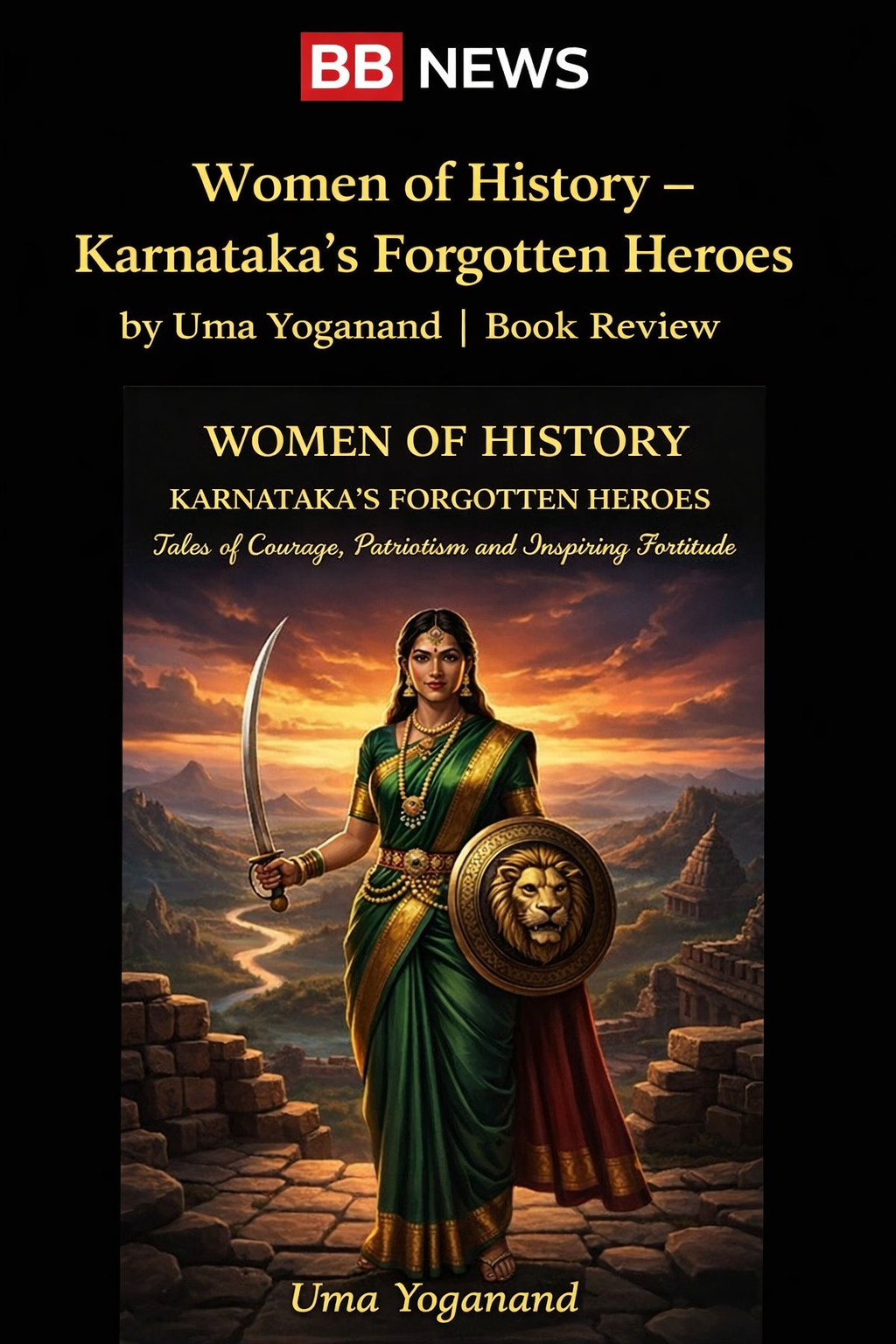
Women of History – Karnataka’s Forgotten Heroes by Uma Yoganand | Book Review
This book is a powerful and engaging exploration of forgotten women warriors from Indian history, brought to life through research, storytelling, and emotion. Blending historical facts with a narrative style, the book focuses on three remarkable queens from Karnataka—Rani Abbakka, Belawadi Mallamma, and Keladi Chennamma—who played decisive roles in resisting powerful empires but remain largely absent from mainstream history books.
The story follows Dr. Asha Rao, a historian whose academic research turns into a personal mission. While working in libraries, archives, and historical sites, she uncovers rare documents, folk songs, sculptures, and royal decrees that point to the extraordinary courage, intelligence, and leadership of these women. As her journey unfolds, the reader is taken from coastal forts and battlefields to dense forests and royal courts, revealing how these queens defended their people through strategy, diplomacy, and unwavering resolve.
One of the book’s strongest aspects is its use of multiple sources—archival records, oral traditions, folk ballads, and material evidence. This approach shows how history is not only written in official documents but also preserved in songs, memory, and culture. The chapters describing guerrilla warfare, diplomatic standoffs, and moral defiance are particularly impactful, yet written in a way that is easy to follow.
The language of the book is simple and clear, making complex historical events accessible to all readers. The author avoids heavy academic jargon and instead presents history in a narrative form that feels alive and relevant. The emotional depth of the women’s stories is handled with sensitivity, highlighting their sacrifices, leadership, and humanity.
More than just a historical account, the book raises important questions about how history is recorded and remembered. It challenges male-dominated narratives and reminds readers that women were not exceptions, but active nation-builders whose contributions deserve recognition.
Overall, this book is an important and timely work. It is ideal for readers interested in Indian history, women’s stories, and cultural heritage. By restoring voice and visibility to these queens, the book succeeds in its larger purpose—to ensure that their legacy is no longer forgotten, but remembered with pride and respect.