
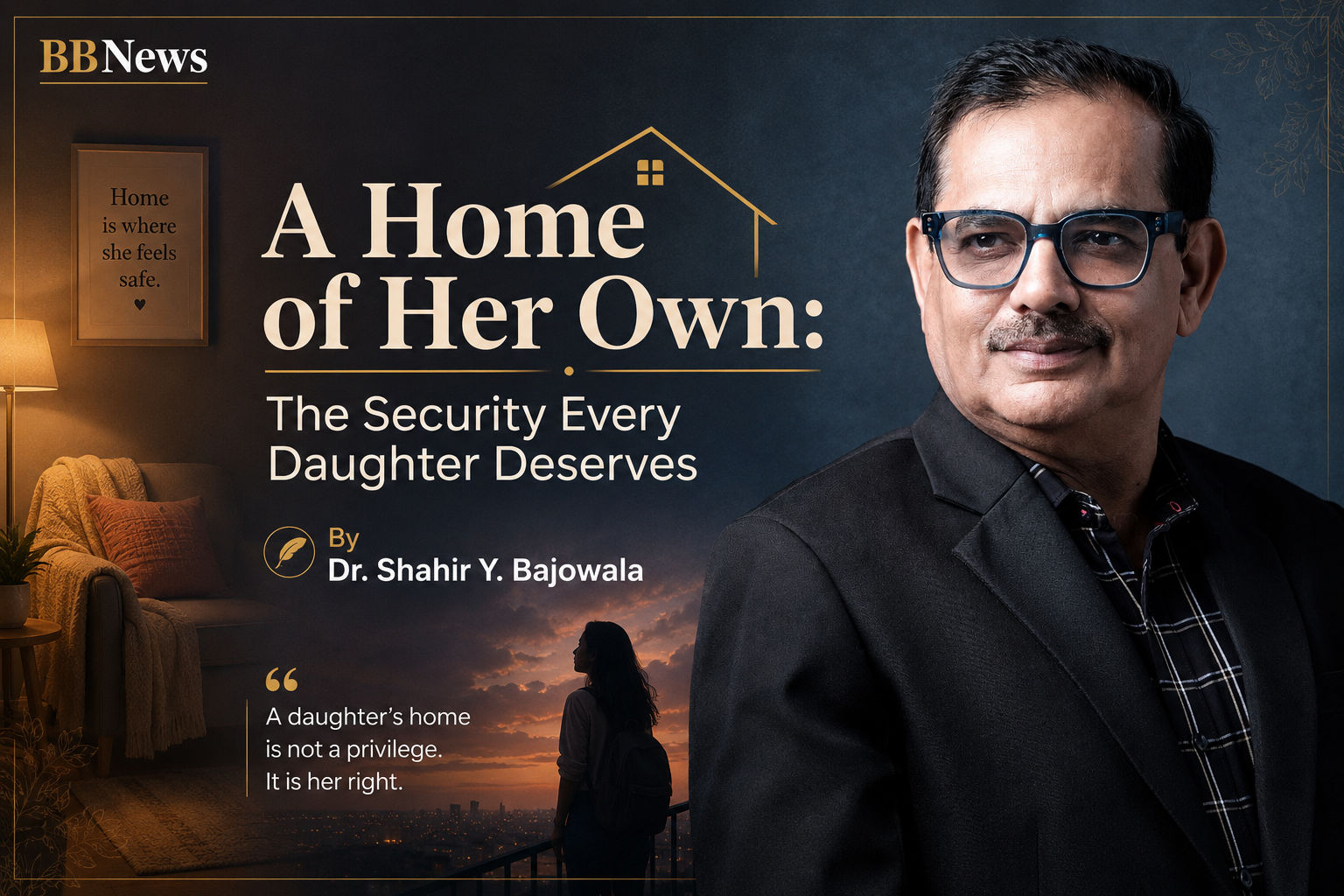
“A Home of Her Own: The Security Every Daughter Deserves” By Dr. Shahir Y. Bajowala
Whenever we speak about women’s empowerment in India, we usually talk about education, employment, equality, confidence, and financial independence. However, I strongly believe that one more important aspect deserves serious attention, and that is the ownership of property in a woman’s own name.
Independent property ownership among women in India remains very low, and figures relating to women who own land exclusively in their own name are often cited at around eight percent. This should make us think deeply because property is not merely an investment. For a woman, it can represent dignity, independence, security, and the confidence that she has something which truly belongs to her.
In India, families often spend a very large amount of money on the marriage of their daughters. There is nothing wrong in celebrating such an important occasion with happiness, but sometimes the expenditure becomes excessive because families feel pressured to impress society. Huge amounts are spent on venues, decorations, clothing, jewellery, catering, entertainment, photography, and many other arrangements that remain memorable for only a few days.
I often wonder whether a meaningful portion of this expenditure could be used more wisely by purchasing a house, apartment, or property exclusively in the daughter’s name. Such an asset could remain with her throughout her life, appreciate in value, generate rental income, and most importantly provide her with a sense of permanent security.
There is also a social contradiction that has always disturbed me. A daughter grows up in her parents’ home with love and belonging, but after marriage she is often described as “parai,” suggesting that she now belongs to another family. Unfortunately, there are also situations where she may be reminded in her husband’s family that she has come from another home and is therefore an outsider.
If the house where she was born becomes her parents’ house and the house where she goes after marriage is considered her husband’s or her in laws’ house, then one has to ask a very simple but important question: which home can she truly call her own?
This is why I believe that along with giving a daughter the best possible education, parents should also consider giving her an independent asset whenever their financial circumstances allow it. The property should ideally be registered only in her name and not automatically in the name of her husband or anyone else, because the purpose is to give her genuine financial security and control over her own asset.
Such a property should not be considered dowry because the intention is completely different. Dowry is connected with marriage expectations, social pressure, demands, or negotiations, whereas the property I am speaking about should be given because she is a daughter and an equal child of the family. Ideally, such financial planning should begin as part of her long term security rather than being linked only to her wedding.
Every parent hopes that a daughter will have a happy, loving, and lifelong marriage, and nobody should plan her future expecting that something will go wrong. However, life can sometimes bring separation, widowhood, financial crisis, illness, family disputes, or other unexpected circumstances. Preparing for such possibilities does not mean expecting misfortune, just as buying insurance does not mean expecting an accident.
Even if a daughter never needs to live in that property, the knowledge that it belongs to her can create enormous emotional and financial confidence. She may rent it, preserve it as an investment, use it later in life, or eventually pass it on to her children.
My belief in this subject is also based on what I have personally seen in my own family. My grandfather had five daughters and one son, who was my father, and he ensured that each of his five daughters received property. When I look back today, I realise how progressive and farsighted his thinking was, particularly for a generation when daughters were not always treated equally in matters of property.
I have seen the same values on my wife’s side of the family. Her grandfather gave property to his daughter, who later became my mother in law, and my father in law continued this tradition by giving property to all three of his daughters. These examples have convinced me that equality should not remain merely a beautiful statement. It should be reflected in real decisions concerning education, inheritance, investments, and ownership.
Perhaps society also needs to change the way it measures the success of a wedding. Instead of asking how grand the venue was, how many dishes were served, or how expensive the decoration looked, we should begin asking whether the bride has received the education and financial foundation needed for a secure future.
A wedding may last for one or two days, but a thoughtfully purchased property can remain with a woman for several decades and may even benefit the next generation. One creates memories, while the other creates memories together with lasting security.
I would therefore encourage every parent, whenever financially possible, to reduce unnecessary wedding extravagance and invest part of that money in the daughter’s future. The property need not be luxurious because even a modest home can become extremely valuable when it gives her genuine ownership, independence, and peace of mind.
There is something deeply reassuring about a woman being able to say that there is at least one home in this world that truly belongs to her. That feeling is not about preparing her to leave her marriage or expecting difficulties. It is about ensuring that she always has choices and never feels completely helpless.
A father cannot protect his daughter from every uncertainty that life may bring, but he can give her education, confidence, values, financial awareness, and, if possible, an independent asset of her own.
The most meaningful gift to a daughter may therefore not be the grandeur of her wedding day, the jewellery she wears, or the celebration that society remembers briefly. It may simply be a home whose documents carry her name and whose door will always remain open to her.
That is not dowry.
That is dignity, equality, foresight, and lasting security.
Dr. Shahir Y. Bajowala