
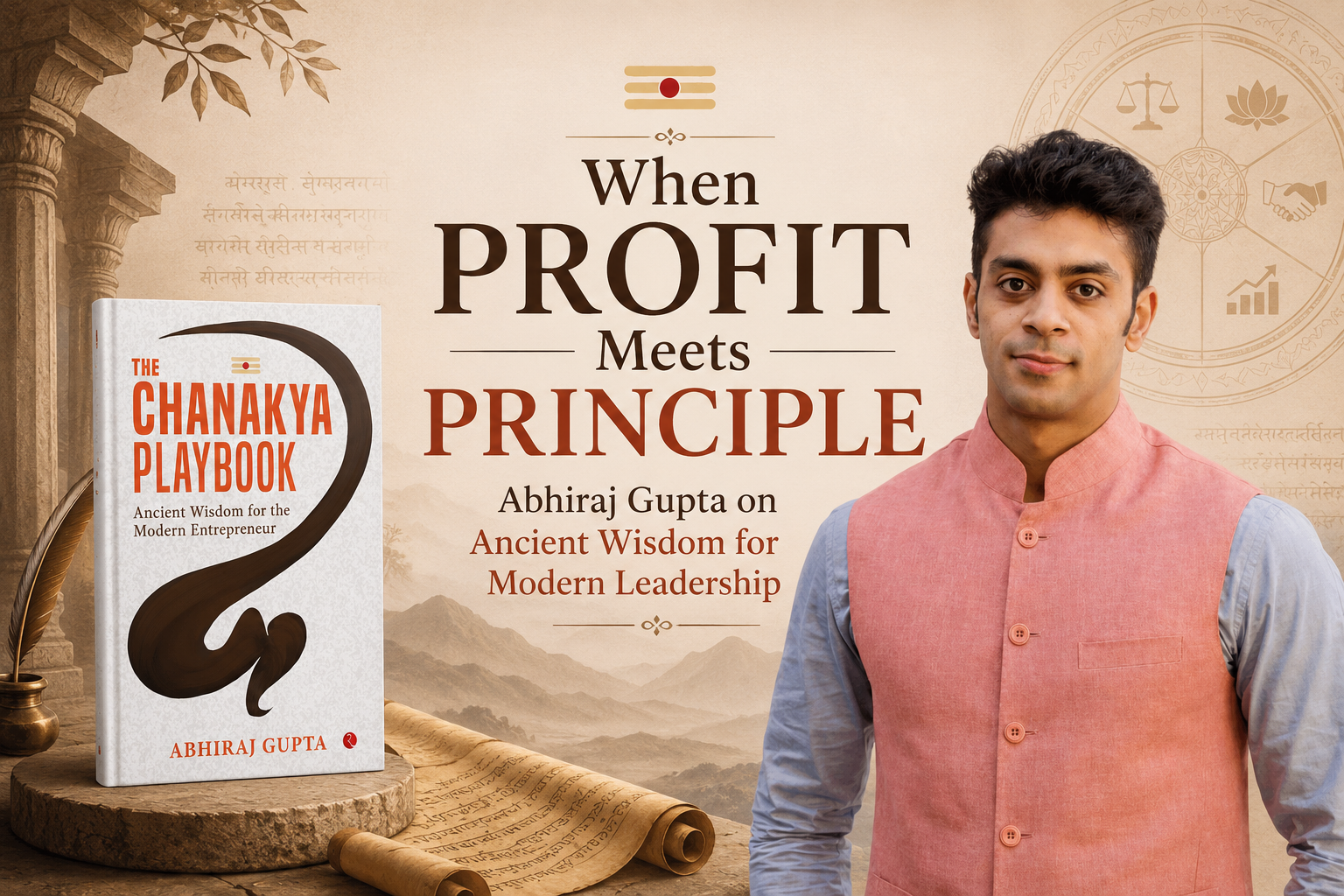
When Profit Meets Principle: Abhiraj Gupta on Ancient Wisdom for Modern Leadership
WHEN PROFIT MEETS PRINCIPLE
What Timeless Wisdom Can Teach the Modern Business World
By Abhiraj Gupta
Modern business has never had more tools. We have dashboards to measure performance, algorithms to predict behaviour, consultants to refine strategy, artificial intelligence to accelerate decision-making, and capital markets that can turn an idea into an enterprise almost overnight.
And yet, despite all this sophistication, many organisations still struggle with the oldest problems known to human society: ego, greed, fear, mistrust, impatience, poor judgement, ethical compromise, weak leadership, and the inability to balance ambition with responsibility.
The tools of business have changed. The human being inside business has not.
That is why ancient wisdom continues to matter.
The Questions Business Still Struggles With
The great scriptures and wisdom traditions of the world were not written as MBA textbooks. The Arthashastra, Chanakya Neeti, Bhagavad Gita, Quran, Bible, and Guru Granth Sahib were not designed to help companies increase quarterly revenue or improve market share. Their concern was far deeper. They examined power, duty, justice, discipline, wealth, humility, action, service, governance, and the moral responsibilities that come with influence.
In many ways, these are exactly the questions business leaders must confront today.
Modern management teaches us how to run organisations. Ancient wisdom asks a more uncomfortable question: what kind of people are running them?
This distinction matters because business is never merely about numbers. Numbers reveal outcomes. They do not always reveal character. A company may grow rapidly and still be fragile. A leader may be intelligent and still be unwise. A business may be profitable and still be ethically hollow. An institution may look successful from the outside while slowly weakening from within.
This is where ancient wisdom becomes surprisingly modern. It reminds us that prosperity without ethics is unstable, power without restraint is dangerous, and leadership without self-mastery eventually becomes a liability.
Strategy Must Begin With Self-Mastery
The Arthashastra understood power, wealth, governance, information, and strategy with remarkable clarity, but it never treated these as isolated instruments. Power had to be organised. Wealth had to be protected. Institutions had to be disciplined. Leadership had to be alert.
The text understood that a kingdom, much like a corporation, does not collapse only because of external enemies. It often weakens because of internal decay – poor systems, complacency, corruption, bad counsel, weak succession, and leaders who stop seeing reality clearly.
This idea sits at the heart of The Chanakya Playbook: Ancient Indian Intelligence for Modern Management as well. The central argument is not that ancient wisdom should replace modern management, but that modern management becomes incomplete when it loses touch with timeless human truths. Strategy is not only about defeating competition. It is also about preventing self-destruction.
The same idea appears in Good to Great by Jim Collins, where the most enduring companies are often led not by loud, ego-driven personalities, but by what Collins calls Level 5 leaders – individuals who combine humility with intense professional will. That thought resonates strongly with Chanakya Neeti, which repeatedly warns against arrogance, impulsiveness, and poor judgement.
The language is different, but the principle is the same: leadership begins with self-discipline.
This is one of the great blind spots of modern business. We spend enormous energy training leaders in communication, finance, negotiation, innovation, and strategy, but far less time training them in restraint, humility, clarity, and inner balance. Yet many corporate failures are not failures of intelligence. They are failures of temperament.
Clarity in the Middle of Conflict
The Bhagavad Gita speaks directly to the inner battlefield of leadership. Arjuna’s crisis is not merely a religious or philosophical moment; it is also a profound study in decision-making under pressure. He is capable, trained, and positioned for action, yet emotionally overwhelmed and morally conflicted. Krishna does not merely push him into action. He helps him find clarity.
Modern leaders face similar dilemmas every day, though in different settings. The battlefield may be a boardroom, a factory floor, a family business meeting, a regulatory crisis, a difficult acquisition, a succession conflict, or an ethical decision where the easier path is not the right one.
The Gita’s message of disciplined action without unhealthy attachment to results is deeply relevant in a world obsessed with valuation, applause, visibility, and comparison. It does not mean results do not matter. They do. But it means leaders must not allow results to distort their identity, judgement, or values.
One must work intensely, prepare sincerely, and act responsibly – without becoming enslaved by success or paralysed by failure.
This idea also connects beautifully with The 7 Habits of Highly Effective People by Stephen R. Covey, especially the principle of working from the inside out. Covey’s argument that private victory precedes public victory echoes what ancient wisdom has long suggested: the outer world of leadership is shaped by the inner world of the leader.
Business often rewards visibility. Wisdom rewards alignment.
Trust as the Invisible Currency of Business
The Quran adds another crucial dimension to this conversation: trust. Its emphasis on fairness in trade, honesty in dealings, justice, accountability, and fulfilment of obligations is deeply relevant to modern commerce. Every invoice, contract, sale, negotiation, and promise is not merely a transaction; it is a test of integrity.
In business, trust is invisible capital. Customers buy because they trust. Employees stay because they trust. Investors commit because they trust. Vendors extend support because they trust. Communities accept businesses because they trust.
Once trust breaks, even the strongest balance sheet begins to look fragile.
This is where the ethical teachings of the Quran resonate with modern ideas found in Conscious Capitalism by John Mackey and Raj Sisodia, which argues that business must serve a broader ecosystem of stakeholders – customers, employees, suppliers, investors, communities, and society. The deeper point is not anti-profit. It is that profit becomes more sustainable when rooted in trust, fairness, and shared value.
The Bible, too, offers a powerful lens for business through the idea of stewardship. A leader is not merely an owner of resources, but a custodian of them. Wealth, talent, opportunity, reputation, people, and influence must be handled with responsibility.
This is extremely relevant in modern corporate governance. A CEO is a steward of shareholder trust. A family business leader is a steward of legacy. An entrepreneur is a steward of an idea that often grows to affect employees, customers, partners, and society.
The biblical emphasis on humility and service also finds a strong modern echo in Servant Leadership by Robert K. Greenleaf and Leaders Eat Last by Simon Sinek. Both works argue, in different ways, that leadership is not domination; it is responsibility. The best leaders do not merely ask how much they can gain from their people. They ask how they can create conditions in which people feel safe, valued, and capable of doing meaningful work.
This is not soft idealism. It is hard strategy.
Organisations built on fear may produce short-term compliance. Organisations built on trust produce long-term commitment.
People, Purpose and the Dignity of Work
The Guru Granth Sahib brings the conversation back to honest work, equality, sharing, and seva. These ideas are profoundly relevant in the business world. Every organisation depends not only on the person at the top, but on the dignity of labour across the entire system – workers, operators, managers, vendors, distributors, administrative teams, and countless invisible contributors.
Modern corporations often speak about culture, but culture begins with how people are treated when they are not powerful. A business that respects only designation and not dignity eventually creates resentment. A business that honours effort at every level builds loyalty, pride, and resilience.
This connects strongly with The Infinite Game by Simon Sinek, where the central idea is that great organisations are not built merely to “win” a finite contest, but to continue playing with purpose, resilience, and responsibility. Ancient wisdom has always understood this. The goal of leadership is not merely temporary victory. It is continuity. It is endurance. It is the creation of institutions that outlast individual ambition.
The Arthashastra would call this institutional strength. The Bhagavad Gita would call it duty with clarity. The Quran would call for justice and trust. The Bible would frame it as stewardship. The Guru Granth Sahib would remind us of honest work and service. Modern management might call it sustainable leadership.
The vocabulary changes. The truth remains remarkably consistent.
Ancient Thought in Modern Management
That is why books like Corporate Chanakya by Dr. Radhakrishnan Pillai have found such wide appeal among professionals. They make ancient strategic thought accessible to the corporate world by showing that Chanakya’s ideas are not locked in history. They can speak to time management, leadership, decision-making, team building, financial prudence, and organisational design.
Similarly, Chanakya in You brings the wisdom of Chanakya into a more personal narrative, showing that ancient learning is not only for kings or scholars, but for individuals navigating ambition, growth, and responsibility.
In the same broad space, books such as The Gita in You, The Difficulty of Being Good by Gurcharan Das, and The Leader Who Had No Title by Robin Sharma remind us that leadership is not merely a position. It is a way of thinking, choosing, and behaving.
The Difficulty of Being Good, in particular, draws from the Mahabharata to examine moral dilemmas, reminding us that ethical decision-making is rarely simple. That is an important lesson for business because most real leadership decisions do not come labelled as purely right or wrong. They come layered with pressure, consequence, loyalty, fear, ambition, and uncertainty.
This is precisely why ancient wisdom is useful. It does not pretend that life is simple. It prepares us for complexity.
What Are We Becoming While We Build?
Modern business often reduces leadership to performance. Ancient wisdom expands it to responsibility.
Modern business asks, “How do we scale?” Ancient wisdom asks, “What are we scaling?”
Modern business asks, “How do we win?” Ancient wisdom asks, “What are we becoming in the process?”
This is not a rejection of ambition. In fact, ancient wisdom is often deeply practical about ambition. The Arthashastra is not naïve. It understands power, wealth, negotiation, competition, and statecraft. The Bhagavad Gita does not ask Arjuna to escape action; it asks him to act rightly. The Quran does not reject commerce; it insists on fairness. The Bible does not condemn stewardship of resources; it warns against greed and misuse. The Guru Granth Sahib does not reject work; it elevates honest work into a spiritual principle.
The message is not “do not succeed.”
The message is: succeed without losing your moral centre.
That is the conversation the business world needs today.
The Future Will Belong to the Wisest Companies
We are entering an age where artificial intelligence will transform industries, automation will change work, supply chains will become more complex, and companies will be judged not only by profits but by trust, transparency, and impact.
In such a world, the future will not belong only to the fastest companies. It will belong to the wisest ones.
This is why ancient scriptures and modern management books need not stand apart. They can speak to one another. Built to Last by Jim Collins and Jerry Porras argues that visionary companies are not built around one charismatic leader alone, but around enduring values and systems. That thought resonates with the Arthashastra’s emphasis on institutional design.
The Effective Executive by Peter Drucker emphasises responsibility, contribution, and disciplined decision-making – ideas that feel deeply aligned with the Gita’s emphasis on purposeful action. Man’s Search for Meaning by Viktor Frankl, though not a business book in the conventional sense, reminds leaders that human beings are driven not only by incentives, but by meaning. That is a lesson every organisation should remember.
Conclusion: Character Is the Final Competitive Advantage
In the end, business is not only about profit. It is about people, trust, discipline, purpose, responsibility, and legacy.
The wisdom traditions of the world remind us that wealth without ethics becomes exploitation, power without humility becomes tyranny, ambition without discipline becomes chaos, and success without purpose becomes empty.
That is why these ideas continue to matter. They do not give us ready-made corporate templates. They give us something far more valuable: principles that help us build better leaders, stronger organisations, and more responsible societies.
In an age racing toward the future, perhaps the most radical thing a business leader can do is pause, reflect, and return to wisdom – because the future of business will not be shaped by technology alone. It will be shaped by character.