
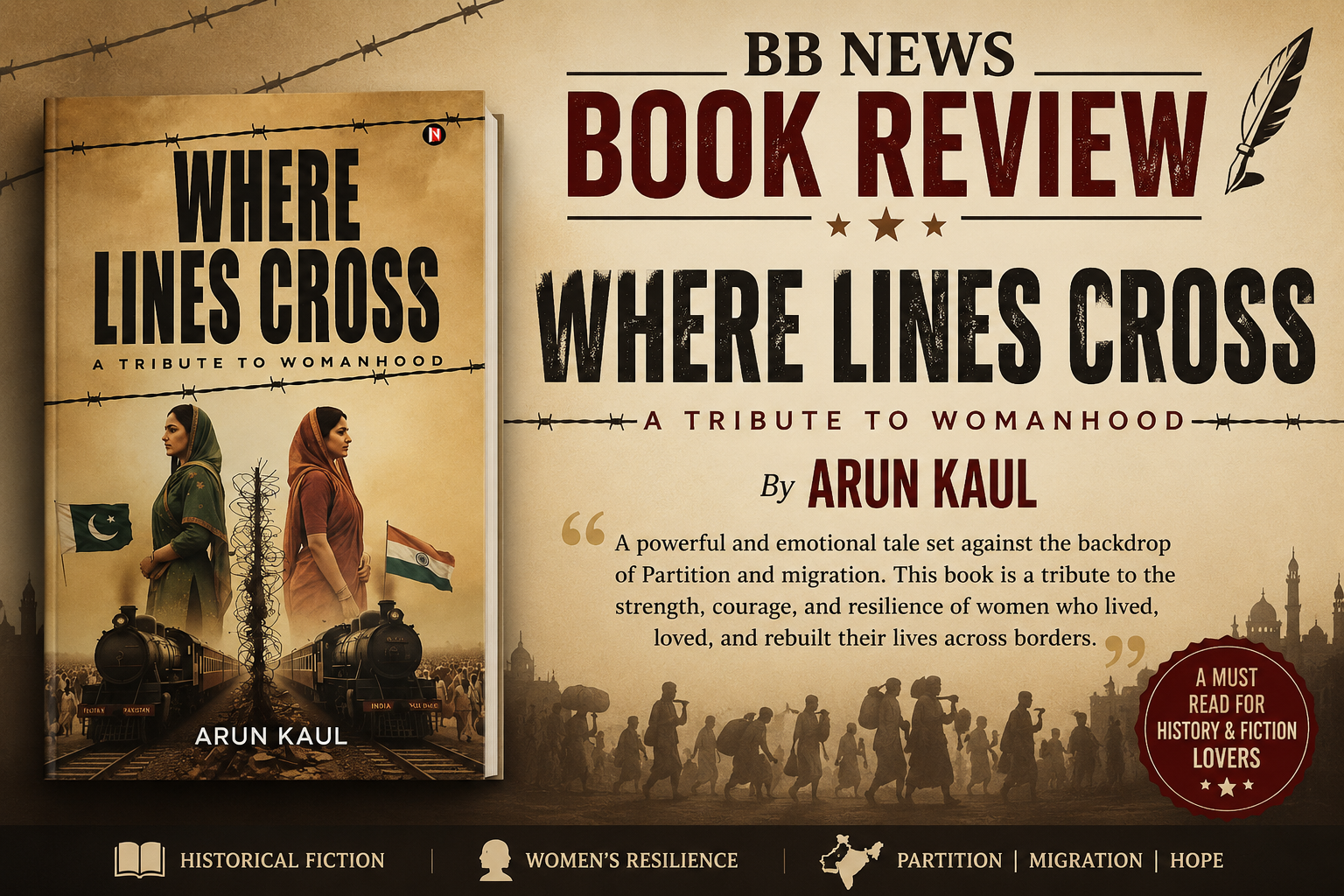
Where Lines Cross: A Tribute to Womanhood by Arun Kaul
The Partition of 1947 changed the course of millions of lives, but history books often focus on borders, politics, and leaders. Arun Kaul’s Where Lines Cross: A Tribute to Womanhood chooses a different path. It tells the story of ordinary people whose lives are shaped by extraordinary events, and in doing so, it becomes a moving tribute to the women who carry families, memories, and traditions through decades of change.
Spanning multiple generations and timelines, the novel follows a wide range of interconnected characters whose journeys unfold against the backdrop of Partition, migration, social transformation, military service, medicine, entrepreneurship, and family legacy. What initially appears to be a collection of individual stories gradually reveals itself as a larger narrative about resilience, belonging, and the invisible threads that connect one generation to the next.
What impressed me most about the book was its ambition. Arun Kaul does not confine himself to a single protagonist or a single period in history. Instead, he creates a broad canvas that stretches from pre-Partition India to contemporary times. Through characters such as Sona, Phoolrani, Bade Baji, Major Vijay, Dr. Arjun, and others, the novel explores how personal choices and historical events shape not only individual lives but entire families.
The subtitle, A Tribute to Womanhood, is particularly meaningful. Although the novel contains stories of doctors, soldiers, entrepreneurs, and community leaders, it is ultimately the women who form its emotional core. Their strength is not always dramatic or heroic in the conventional sense. Instead, it is found in endurance, sacrifice, nurturing, and the ability to preserve family bonds during periods of upheaval. Whether facing displacement, uncertainty, loss, or social expectations, the women in the novel emerge as quiet yet powerful forces that hold generations together.
Another aspect that stood out to me was the way the author portrays history. The Partition is not presented merely as a political event but as a deeply personal experience. Readers witness its effects through families forced to leave their homes, communities struggling to adapt, and individuals attempting to rebuild their lives after devastating loss. The emotional impact comes not from grand historical speeches but from everyday moments of fear, hope, and determination.
The novel also explores themes beyond Partition. Chapters involving military life, healthcare, education, and institution-building reflect the changing aspirations of modern India. Through these storylines, Arun Kaul shows how each generation faces its own challenges while remaining connected to the values and sacrifices of those who came before.
The writing style is straightforward and accessible, allowing readers to focus on the characters and their experiences. Because the book spans many years and includes a large cast of characters, readers may occasionally need to pay close attention to relationships and timelines. However, this complexity also contributes to the richness of the narrative and reinforces the sense of a living, evolving family history.
As a reader, what stayed with me most was not a particular event or character but the novel’s central message: history is ultimately carried forward through people. Borders may change, generations may pass, and circumstances may evolve, but love, memory, sacrifice, and resilience continue to connect lives across time.
Where Lines Cross: A Tribute to Womanhood is more than a historical novel. It is a family saga, a reflection on India’s journey through change, and above all, a heartfelt tribute to the women whose strength often goes unrecorded but never goes unnoticed. Arun Kaul has created a story that is both personal and expansive, reminding readers that behind every chapter of history are ordinary people whose lives deserve to be remembered.
Rating: 4.5/5