
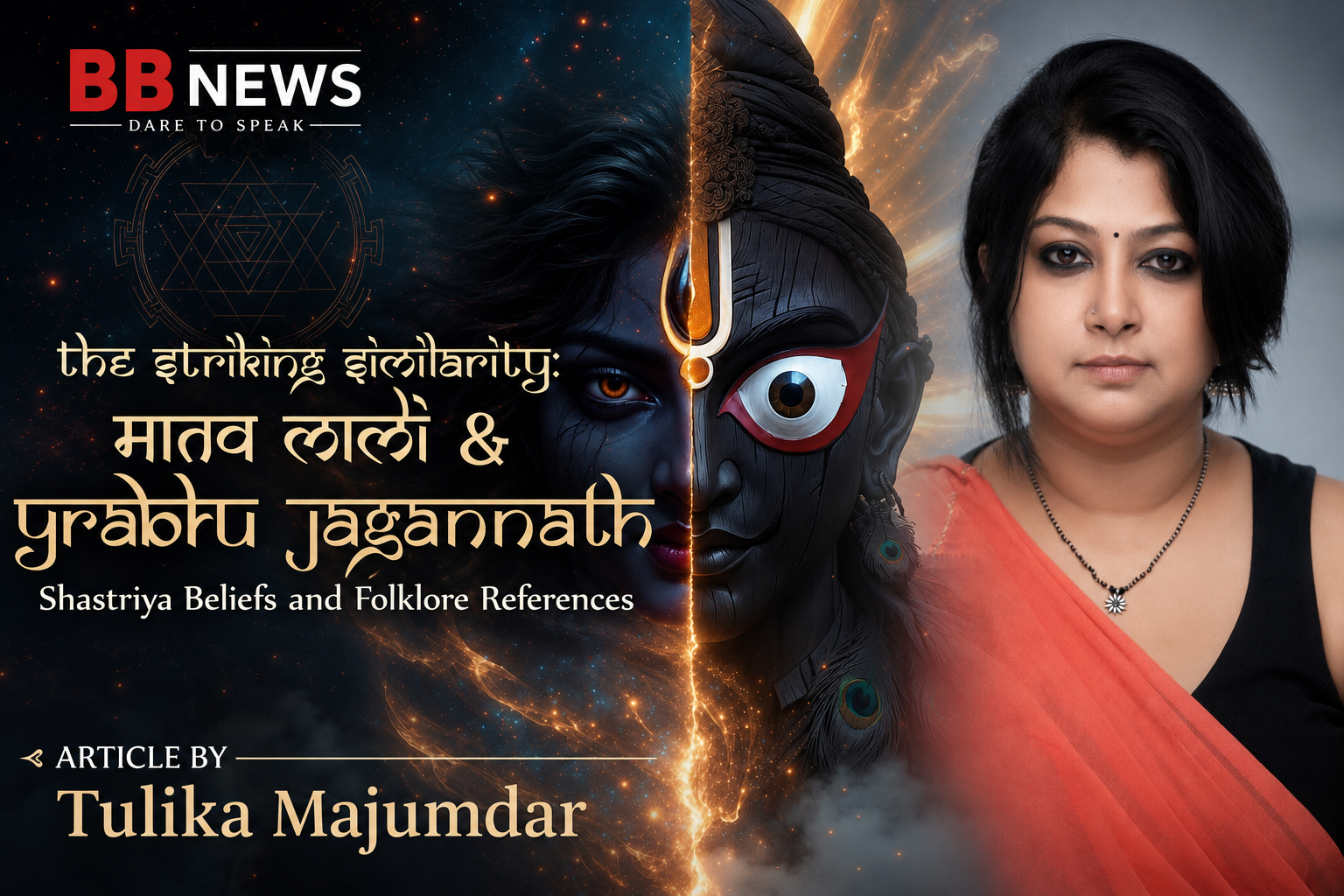
The Striking Similarity: मातव मलों & Prabhu Jagannath By Tulika Majumder
The striking similarity between the faces of Prabhu Jagannath and Maha Kali has amazed devotees, thinkers, and spiritual seekers in India for a long time. Both gods show faces that look different from the usual human-like shapes of other Hindu gods. Lord Jagannath’s idol in the holy temple of Puri in Odisha has a wide square face with very big round eyes that seem to watch the whole world. In the same way, Ma Kali, especially in her strong forms worshipped in Bengal and other places, has a dark intense face with wide sharp eyes that show both fear and kindness. These common features like big eyes without lids, a simple non-human look, and a feeling of endless space point to deep meanings from old holy texts and old stories.
At first look, people might think this match comes just from art styles or local ways of making idols. But the holy books and special spiritual teachings show a real deep link. In Hindu thought, especially in Shakti worship and Tantra ways, Jagannath is not only a form of Vishnu or Krishna. He stands for the highest truth that goes beyond all differences. Tantric holy writings see Jagannath as Maha Kali or the Dakkhina Kali. Special Odia texts say Jagannath sits on the Kali Yantra and is called with the holy sound “Klim,” which is also used for Kali and the goddess power. This sound links the lord of everything directly to the goddess of time, ending, and change.
This link shows the big idea that all is one. Jagannath, called the wood form of the highest power, shows the shapeless truth taking a simple shape. His dark color, huge eyes like sun and moon, and no arms or legs bring to mind endless time, which Kali stands for as the one who ends things to give freedom. Holy books like the Kalika Purana describe Jagannath as a Tantric god, mixing loving worship of Vishnu with the strong power of Shakti. In this thinking, the similar faces are not by chance. They show how Vishnu’s care joins with Kali’s ending power to make a full picture of the world’s cycle. Devotees feel Jagannath’s eyes watch everything, just like Kali’s look that cuts through false ideas to show real truth.
Old stories from Odisha and Bengal add more light to these ideas. One well-known tale links the start of Jagannath to the heart of Lord Krishna that did not burn after he left earth. A simple forest devotee found this holy part, and King Indradyumna later put it in a wood form as God told him. In some versions of this story, the wood from the sea shows a mix of Krishna’s loving side with the first mother power. Some spoken tales in Puri and Kolkata say quietly that Jagannath and Kali are two sides of the same god power. One story tells of a devotee in Kalighat who saw Ma Kali appear with the calm strong look of Jagannath, showing they both protect and give freedom.
In Bengali old tales, links between Puri’s Jagannath temple and Kolkata’s Kalighat Kali temple show matching customs. Both places have secret holy centers and gifts that go beyond normal worship. Devotees tell how in some festivals, putting Vishnu marks on Kali’s idol or sharing sandal paste shows that Krishna-Jagannath and Kali are not different. A nice story is about the great thinker Sri Ramakrishna, who saw no gap between Jagannath, Kali, and Krishna. His deep visions supported the idea that these shapes are the same mother-father power, reached through love and faith. Such tales are sung in prayer meetings where people praise “Jagannath Kali” as the time lord of all.
The way the idols are made gives another clue. Jagannath’s idols are changed every few years in a special wood renewal rite, cut from holy neem tree into simple shapes that focus on meaning more than real body parts. This is like some Kali forms in village or simple traditions, where wood pieces stand for the goddess’s raw power. Experts note roots from local worship, where wood logs showed gods linked to forests and mother power. The big round eyes shared by both mean full seeing for Jagannath and watchful care for Kali. These looks avoid pretty decorations for a straight strong meeting with God that makes the person feel small.
Holy beliefs stress the mixing of ways. The Jagannath worship brings together Vishnu love, Shiva power, Shakti strength, and even Buddhist and Jain parts. This shows Odisha’s past as a place where cultures joined. Texts call Jagannath the best person, yet in special practices he acts as Bhairava, partner to Vimala who is like Kali. During the rest time after the bathing festival, old tales say Jagannath takes a more Kali-like side of fresh start and deep thought. This round worship matches Kali’s link to the wheel of time, where ending makes room for new beginning. Devotees believe thinking on this match helps feel oneness, breaking walls between groups.
In real daily worship, this link shows clearly. The holy food of Jagannath becomes fully blessed only after offering to Vimala, matching step-by-step mother power ways. Travelers to both Puri and Kalighat often feel a smooth flow, as if the same caring power greets them. Old tales from north Bengal and Odisha tell of wonders where prayers to one were answered by the other’s kindness, like a sick person healed after promising to both. These stories strengthen the holy view that gender and shape differences are just tricks hiding the one big truth.
In deeper thought, the match makes us think about God’s many sides. Jagannath’s easy loving reach as “Lord of the World” goes well with Kali’s strong mother care. Both break normal rules — Jagannath by taking gifts from all groups and communities, Kali by her free wild shape. Their faces, with those magic eyes, pull the seeker inside, past outside looks to the center of giving up. In times of many faith paths, this picture and teaching link helps bring peace, reminding us that care and strength, keeping safe and changing, cannot be split.
The lasting draw is in this mystery. Whether in the big chariot festival of Puri or the deep Kali prayer nights, devotees feel the beat of the same world power. Holy texts and old tales come together to teach that seeing this match is not just looking but a step to finding God inside oneself. Prabhu Jagannath and Ma Kali, with their very similar faces, stand as forever signs of the truth that the world is one, held in the look of the endless.