
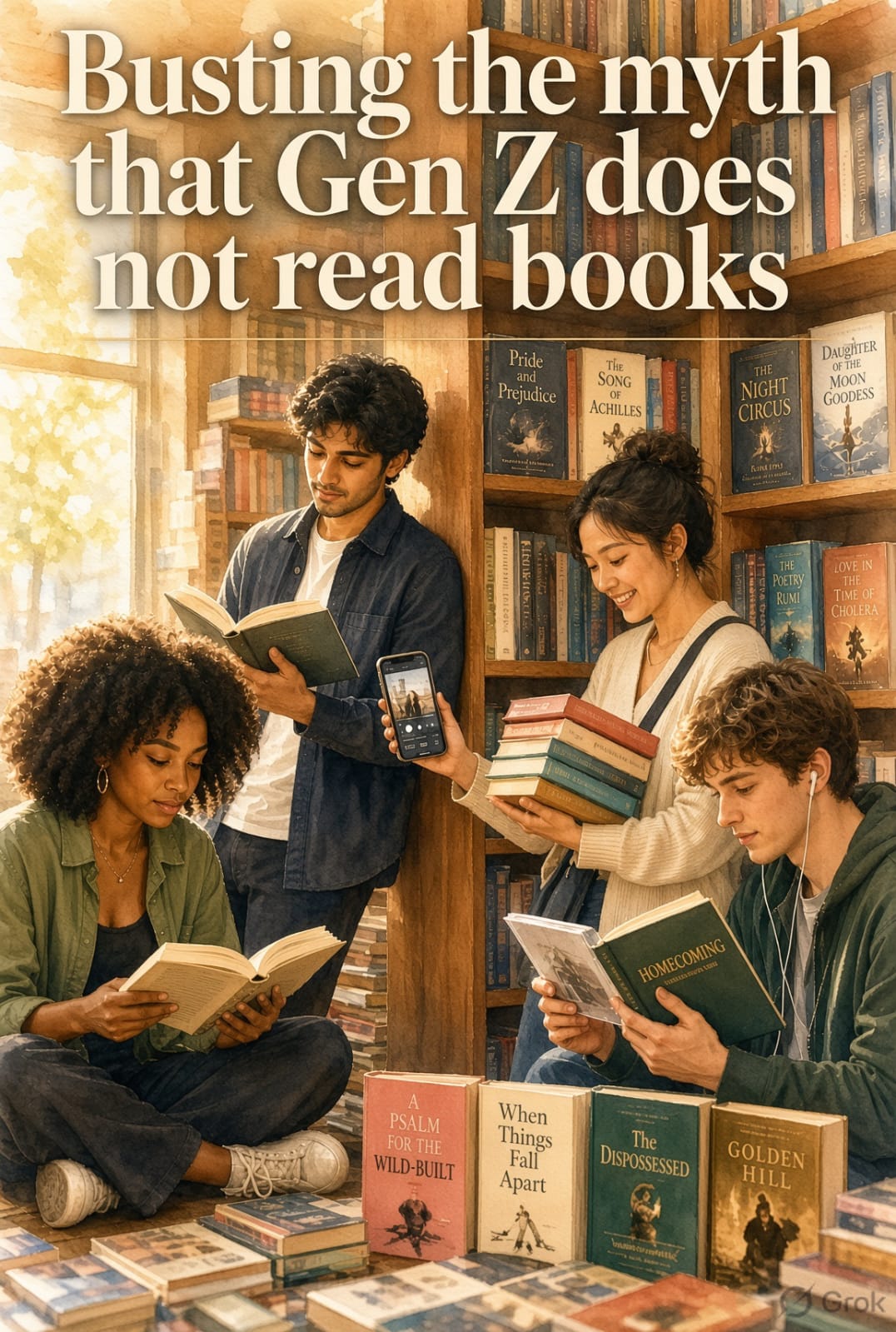
Busting the Myth “Gen Z avoids reading books” by Tulika Majumder
It’s convenient, and largely wrong, to say that Generation Z doesn’t read. What has changed is not so much appetite as the very map of literature: where books are found, what counts as a book, and what feelings a story is supposed to deliver. Readers born between about 1997 and 2012, in many continents, treat literature as entertainment, as identity work, as digital community, and, surprisingly often, as a physical object they still want to hold.
Surveys are constantly deflating the panic. In 2025, in research on how Gen Z finds books, 66% of the cohort identified as readers, up 14 points from 2022, and 65% had read at least one print book in the last year. Gen Z is the most bookish age group in Spain, according to consumer surveys around World Book Day 2025, with just around one in ten saying they had not read anything in a year. Jakpat data from Indonesia: Gen Z reads more books than millennials or Gen X, aided by the concept that reading is a way of life, not homework The overall reading rate in South Korea continued to decline, but only the 20s were able to bounce back, riding a text hip fashion where books look modern again.
The generation is not homogenous. Some young adults can barely finish a novel. Others line up annotated paperbacks next to Webtoon tabs and midnight audio chapters. The question is not are they reading, but what are they reading.
For much of the English-speaking world, and increasingly beyond it, discovery is via short video. BookTok, TikTok’s reading community with hundreds of billions of views, can send a midlist title to the bestseller shelves in days. Romance and romantasy rule the feed: Sarah J. Maas’s A Court of Mist and Fury, Rebecca Yarros’s Fourth Wing, and Colleen Hoover’s contemporary heartbreak novels are as much seasonal events as books. Nielsen tracking across European markets has long linked fiction growth, particularly romance, crime and fantasy, to that same pipeline.
The effect is not American only . Most of the best-selling English language titles in Romania have BookTok fingerprints. In Brazil, adolescents pack book fairs for Lynn Painter rom coms and Yarros’s dragon rider saga. In Finland, young readers are increasingly opting to pass up waiting for a Finnish translation and buy the English original so they can jump in on the conversation in real time. This is a headache for local publishers, and a sign that Gen Z literature is now a global, almost simultaneous market.
In many places, print still wins the battle of the best. In some international snapshots, roughly seven in ten Gen Z readers want paper. Researchers cite digital fatigue, the look of a book on camera, and the simple fact that a novel does not ping. Libraries and independent stores are thriving. Gen Z visits to bookstores and public libraries increased in U.S. survey work 2022–25, and librarians regained influence as recommenders.
That preference lives alongside a sprawling digital diet. Gen Z readers in China on key platforms read dozens of titles a year, plus more than an hour a day of screen reading, with peaks late at nite; for many, audiobooks add another long daily session. E-book reading rates among South Korean twenty-somethings now surpass print reading rates. Vietnamese users aged 18-24 are the most active on digital platforms like Waka. A hardback from a high street shop shares the same literary life as Wattpad, Webtoon, Qidian and the like. Most Gen Z and millennial respondents in a 2024 Wattpad survey embraced webnovels, e books, and webcomics, and actively sought out queer and minority stories that bookstores continue to underprovide.
Feeling has leveled genre hierarchies. Romance is the world’s loudest commercial engine: In some measures, U.S. print romance has more than doubled since 2020, and the same trend prevails in Latin American markets: high teen and young women share for romance in Spain; a surging digital romance in Colombia; erotic and dark romance at the top of Brazilian Kindle shelves, with women comprising the core of heavy book buyers. Fantasy works best when it’s a mix. Academy settings, dragons, morally ambiguous love interests, cozy magic.
It’s defined by critics, and literary fiction has a harder time unless it can be reframed as an emotional hook. Publishers in India say prestige novels are being outsold by commercial romance, fantasy, thrillers and self-help among younger buyers. Mental health memoirs, boundary setting guides, and narrative self help travel well because they promise tools, not only style. But the classics return through the same social machinery that sells romantasy. TikTok has propelled Dostoevsky’s White Nites and Salinger’s The Catcher in the Rye onto youth charts. Chinese platform lists mix The Art of War, The Analects, The Three Body Problem, The Kite Runner and One Hundred Years of Solitude. Nostalgia is also on the menu: Gen Z rates high for re-reading childhood series such as Harry Potter and The Hunger Games.
East Asia is the laboratory for serialized digital fiction. China’s online literature industry feeds Gen Z with fantasy, slice of life, light novels, science fiction and history, treating updates like a season of a TV show. Korea and the wider webtoon market bundle comedy, romance and ever more sci fi into vertical scroll comics made for the phone. Asia Pacific still accounts for the bulk of that market even as North American spending rises. Despite the proliferation of apps like readAwrite, surveys of student readers of new books, including detective stories, boys’ love stories and romance, reveal that physical books are still the preferred choice in Thailand. Japan muddies the waters. A University of Tokyo study of students aged 18 to 29 found that around one in five do not read books, newspapers, magazines or even manga in their everyday lives.
The youth market in South Asia is growing fast. India’s book business is huge and getting bigger; publishers say fiction and personal development titles are attracting millennials and Gen Z, including first-time buyers in smaller cities. Parks and clubs have become venues for public reading — Delhi Reads, Cubbon Reads in Bengaluru — where loneliness and the desire to be seen as a reader converge. A few cross country snapshots show poetry as a surprisingly strong preference in India and a handful of other nations.
Africa’s story is twofold: access and invention. Reading culture in Nigeria is said to be under strain but library visits and book lending at institutions like ZODML rose dramatically in 2025, and poetry prizes attracted thousands of student submissions. Publishers talk of a renaissance: locally rooted romance and contemporary fiction selling across Kenya, Ghana and South Africa; young writers self-publishing comics and novels online; audio platforms catching phone-first teenagers. Hausa popular fiction, which once existed in cheap print in northern Nigeria, now has massive audiences on Wattpad. Meanwhile, South African publishers describe the same tactile, BookTok adjacent return to print seen in the West.
Latin America is folding global English hits into a boom of local romance authors and independent digital writers. Teens are flocking to Rio’s Bienal do Livro to find the titles their For You page has already sold them The dark romance readers of Mexico and the digital romance readers of Colombia both want complicated heroines, not decorative ones.
Europe is both a producer of BookTok English and a reminder of the pressure on national languages. According to German data, BookTok has influenced tens of millions of copies sold in a single year. Spanish youth are combining police thrillers, romantasy and a weird swell in poetry. While they use Archive of Our Own and buy on the strength of Instagram just as much as they do TikTok, Slovenian humanities students still browse shops and libraries.
Amidst the regional noise, some demands are heard. Gen Z readers want pace and a turn they can cut into a video. They want characters who feel contemporary in their anxiety and queerness and anger and moral smudginess. Community, comment threads, silent reading picnics, annotated copies passed among friends. Many also want a break from the feed, which is why the paperback keeps winning even as hours are gobbled up by webtoons and audio.
They are not so much replacing the novel as rejecting a definition of literature. You can have a Qidian cultivation saga and a Lagos romance and a webtoon episode and a Maas doorstopper and a reread of The Art of War all in one week. The literary choice of the generation, globally, is less canon than playlist: high-emotion genre first, classics when they hit a nerve, local languages when they are easy to find, English when the conversation is already happening there.
If older critics hear only noise, they are listening to the wrong instrument. Gen Z didn’t abandon the book. They networked it up.