
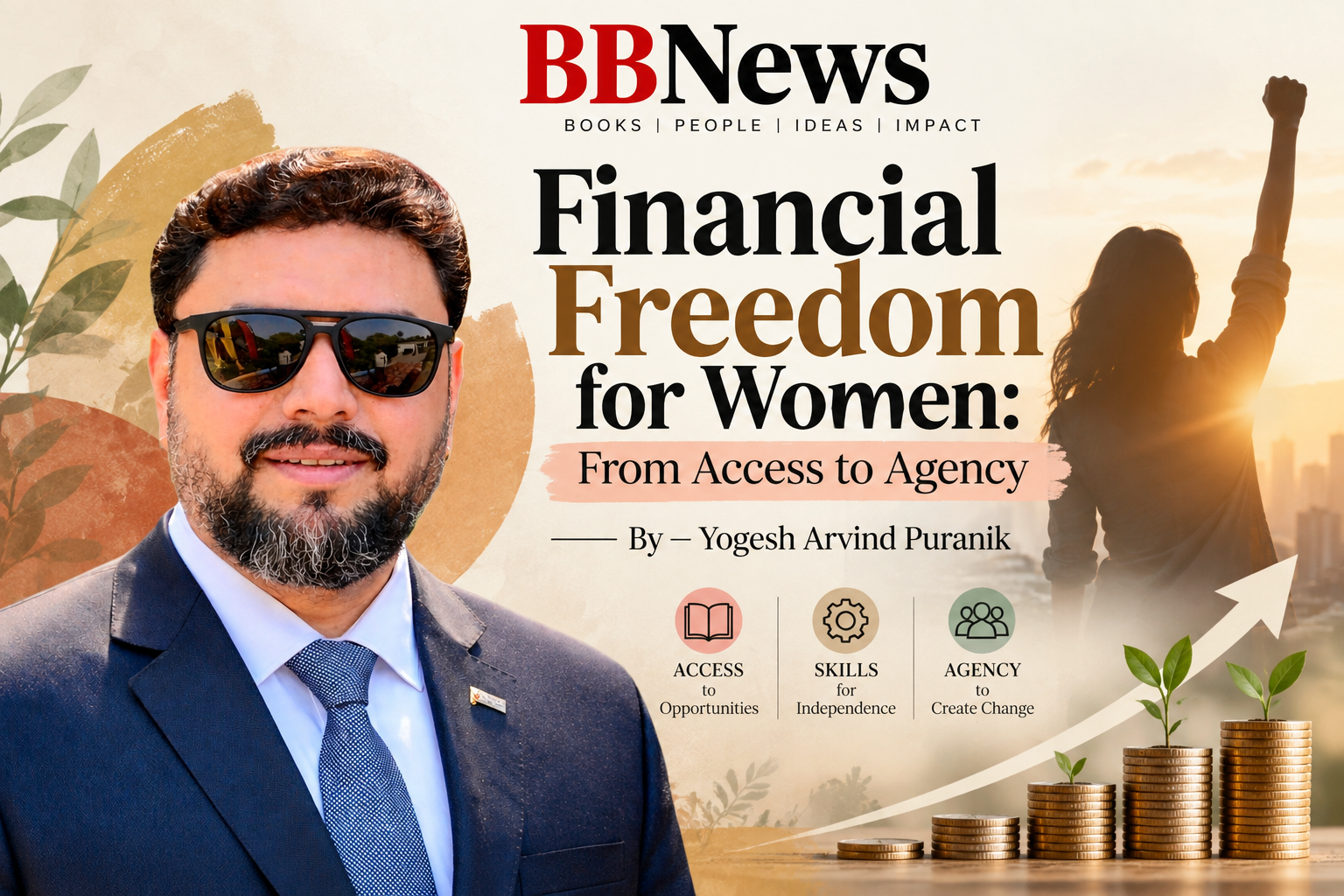
Financial Freedom for Women: From Access to Agency — by Yogesh Arvind Puranik
Financial freedom is often described as the ability to earn, save and spend without dependence.
For women, however, it means something larger: the right to control income, own assets, make economic decisions, pursue dignified work, withstand financial shocks and shape the future of the family and society. It is not merely a question of opening bank accounts or increasing the number of women in the labour force. It is a question of agency—of whether a woman can decide what happens to the money she earns, whether she can inherit and own property, whether she has access to credit, and whether unpaid care work is recognised rather than treated as an invisible obligation.
The case for women’s financial freedom is therefore both moral and economic. The United Nations’ Sustainable Development Goal 5 calls for women’s equal rights to economic resources, land, property, inheritance and financial services, as well as recognition of unpaid domestic and care work. Yet the world remains far from that ambition. The World Economic Forum’s Global Gender Gap Report 2026, covering 145 economies, found that 69.2% of the global gender gap has been closed—a marginal improvement from 68.8% in 2025. At the current rate of progress, full parity remains 120 years away.
The Meaning of Financial Freedom
Women’s economic disadvantage does not arise from a single barrier. It is produced by a chain of interlocking inequalities.
A girl may receive less education than her brother. A young woman may be encouraged to choose a “safe” but poorly paid occupation. After marriage, she may withdraw from paid work because childcare, eldercare and household labour are assumed to be her responsibility. Even when she earns an income, she may not control it. She may lack property in her own name, a formal credit history, digital access, knowledge of investment or protection against violence and discrimination.
This is why financial inclusion must not be confused with financial empowerment. A bank account that remains inactive, a loan that creates indebtedness without market access, or employment without fair wages does not by itself create freedom. Genuine empowerment requires access, use, control and security.
The global evidence makes the scale of the challenge clear. According to the International Labour Organization, 708 million women worldwide were outside the labour force in 2025 because of unpaid care responsibilities, compared with just 40 million men. Women’s global labour-force participation stood at around 48%, against 73% for men, and women earn on average 23% less than men while performing more than three-quarters of all unpaid care work.
India Reflects Both Progress and Contradiction
Female labour-force participation in India has shown encouraging momentum, rising to 35.3% in February 2026 and reaching 34.8% in August 2026, with rural female participation at 39.4%. While this represents progress, it still lags male participation substantially.
At the same time, India’s Time Use Survey reveals that women spend an average of 363 minutes a day on unpaid domestic and care work—nearly three times the 123 minutes recorded for men. The Economic Survey 2025–26 noted that about 41% of women aged 15–59 reported participating in caregiving activities, compared to 21.4% of men in the same age group.
The central lesson is straightforward: women cannot achieve financial freedom if they are given accounts but not assets, loans but not markets, jobs but not safety, or education but not decision-making power.
India’s Policy Response
The Government of India has developed a wide ecosystem of initiatives addressing financial access, entrepreneurship, livelihoods, social protection, skills, safety and care. These schemes differ in design and reach, but together they represent a shift from welfare for women to women as economic participants and, increasingly, as leaders of development.
Banking and Financial Inclusion
The Pradhan Mantri Jan-Dhan Yojana has been one of the most consequential interventions. It brought millions of previously unbanked people into the formal financial system and enabled direct transfer of welfare payments.
As of August 2026, more than 59 crore Jan-Dhan accounts had been opened, with women holding 56% of them and 78% located in villages and small towns. Deposits in these accounts have crossed ₹3.1 lakh crore, and ₹53 lakh crore has been transferred directly to beneficiaries through the JAM (Jan Dhan-Aadhaar-Mobile) trinity. By August 2026, the number of women beneficiaries under the scheme stood at approximately 32.92 crore.
This expansion matters because an account can become the foundation for savings, insurance, pensions, credit and independent receipt of income. However, the next policy challenge is active and meaningful use: regular savings, secure digital transactions, access to affordable credit and control over the account by the woman herself.
The Reserve Bank of India’s Financial Inclusion Index reached 70.0 for the year ending March 2026, up from 67.0 in March 2025, with growth witnessed across all sub-indices.
Credit and Entrepreneurship
The Pradhan Mantri Mudra Yojana provides loans for small, income-generating enterprises in manufacturing, trade, services and allied agricultural activities. It has become an important channel for women who operate micro-enterprises, home-based businesses and informal ventures.
The scheme’s loan ceiling was raised from ₹10 lakh to ₹20 lakh, with a new “Tarun Plus” category for eligible entrepreneurs who have successfully repaid earlier loans. Notably, two out of every three Mudra loans have been given to women.
The Stand-Up India scheme seeks to promote entrepreneurship among women and Scheduled Caste and Scheduled Tribe borrowers by facilitating bank loans of ₹10 lakh to ₹1 crore for greenfield enterprises. As of March 2025, women borrowers accounted for more than 2.05 lakh sanctioned accounts, with sanctioned loans totalling approximately ₹48,010.73 crore. More recent data indicates that the scheme has facilitated over 2.27 lakh loans amounting to ₹52,474 crore to women entrepreneurs.
Credit, however, is only one part of entrepreneurship. Women-owned enterprises also need business training, digital tools, market connections, reliable infrastructure, childcare, insurance and freedom from discriminatory lending practices. A loan without these supports can increase risk rather than autonomy.
Self-Help Groups and Rural Livelihoods
The Deendayal Antyodaya Yojana–National Rural Livelihoods Mission has created one of the largest platforms for collective economic action by rural women. It organises women from poor households into self-help groups, links them with banks, supports savings and credit, and assists with livelihood diversification and enterprise development.
By October 2025, the programme had mobilised 10.05 crore women into more than 90.90 lakh self-help groups across 28 States and six Union Territories. By March 2026, this had expanded to 94.31 lakh self-help groups with 10.14 crore members across 34 States and Union Territories.
The importance of self-help groups extends beyond finance. They can strengthen bargaining power, collective purchasing, access to government services, local leadership and social confidence.
Social Protection, Safety and Care
Economic participation cannot be sustained without social protection and safety. Mission Shakti, the Government’s umbrella programme for women’s safety, security and empowerment, brings together interventions intended to support women across the life cycle. Its structure includes the Sambal and Samarthya components, along with mechanisms for support, protection, childcare and empowerment.
The Union Budget 2026–27 reported ₹5.01 lakh crore for the welfare of women and girls through the Gender Budget Statement, representing an increase of 11.55% over the previous year’s allocation of ₹4.49 lakh crore. Such allocations are important, but their value depends on implementation, transparency and measurable outcomes.
Care policy is particularly significant. Affordable childcare, safe transport, sanitation, healthcare and eldercare can release women’s time for education and paid work. Without investment in the care economy, women are often expected to enter the labour market while continuing to perform almost all unpaid domestic labour.
Global Initiatives and Commitments
India’s efforts form part of a larger international movement. Several global initiatives provide frameworks, standards and financing for women’s empowerment.
The Sustainable Development Goals: Sustainable Development Goal 5 seeks to achieve gender equality and empower all women and girls. Its targets include ending discrimination and violence, eliminating harmful practices, recognising unpaid care work, ensuring women’s participation in leadership, expanding access to economic resources and using technology to promote empowerment.
Generation Equality: Convened by UN Women with governments, civil society, youth groups, businesses and philanthropists, Generation Equality seeks to accelerate implementation of the Beijing Platform for Action and the 2030 Agenda. Its Action Coalition on Economic Justice and Rights focuses on transforming the care economy, expanding decent work, improving women’s access to and control over productive resources, and promoting gender-transformative economic systems.
Women’s Economic Empowerment Strategy: UN Women’s economic empowerment framework defines empowerment as women’s equal access to and control over resources, assets, income and time, together with agency and participation in economic decisions.
Women’s Empowerment Principles and Corporate Action: The Women’s Empowerment Principles, developed by UN Women and the UN Global Compact, offer a framework for businesses to promote gender equality in the workplace, marketplace and community.
International Finance and Entrepreneurship: The World Bank Group Gender Strategy 2024–2030 focuses on foundational wellbeing, economic participation and women’s leadership. Its Women Entrepreneurs Finance Initiative has facilitated over US$7 billion in financing for more than 600,000 women-led businesses across 81 countries.
The World Bank’s Global Findex 2025 reported that 77% of women globally had an account with a financial institution or mobile-money provider, compared with 81% of men.
What an Individual Can Do in India
Government programmes can create opportunity, but social change is completed in households, workplaces, markets and neighbourhoods. Individuals can contribute through practical, sustained choices.
Families can treat daughters’ education, digital access and financial literacy as essential investments. Women should be encouraged to hold accounts in their own names, understand interest and taxation, maintain secure digital practices, nominate beneficiaries and participate in decisions about savings, insurance and property.
Households can also redistribute unpaid work. Men and boys should share cooking, cleaning, childcare and eldercare—not as “help” offered to women, but as a responsibility that belongs equally to everyone.
Individuals can support women’s economic participation by buying from women-owned businesses, recommending women for jobs and leadership opportunities, offering transparent pay and safe workplaces, mentoring women, helping them access legitimate financial and government services, and avoiding predatory loans, fraudulent investment schemes and unregulated financial advice.
Toward Freedom, Not Merely Inclusion
The future of women’s financial freedom will be determined by whether societies move from symbolic inclusion to structural equality. Opening an account is valuable; ensuring that a woman can use it freely is more valuable. Offering a loan is valuable; ensuring that she has markets, skills and protection is more valuable. Inviting women into the workforce is valuable; redesigning work so that care is shared and safety is guaranteed is more transformative.
India has created significant institutional foundations: mass banking, self-help groups, microenterprise credit, entrepreneurship schemes, gender budgeting, social protection and an expanding policy vocabulary of women-led development. The unfinished work is to ensure that these structures produce durable changes in income, assets, time, security and authority.
Women’s financial freedom should therefore not be imagined as a private benefit enjoyed by a few successful individuals. It is a public good. When women can own, earn, decide and lead, families become more resilient, economies become more productive and democratic life becomes more representative. The goal is not simply to help women enter an existing system on unequal terms. It is to build an economic order in which women’s labour is visible, their time is respected, their property is secure, their choices are protected and their freedom is ordinary rather than exceptional.