
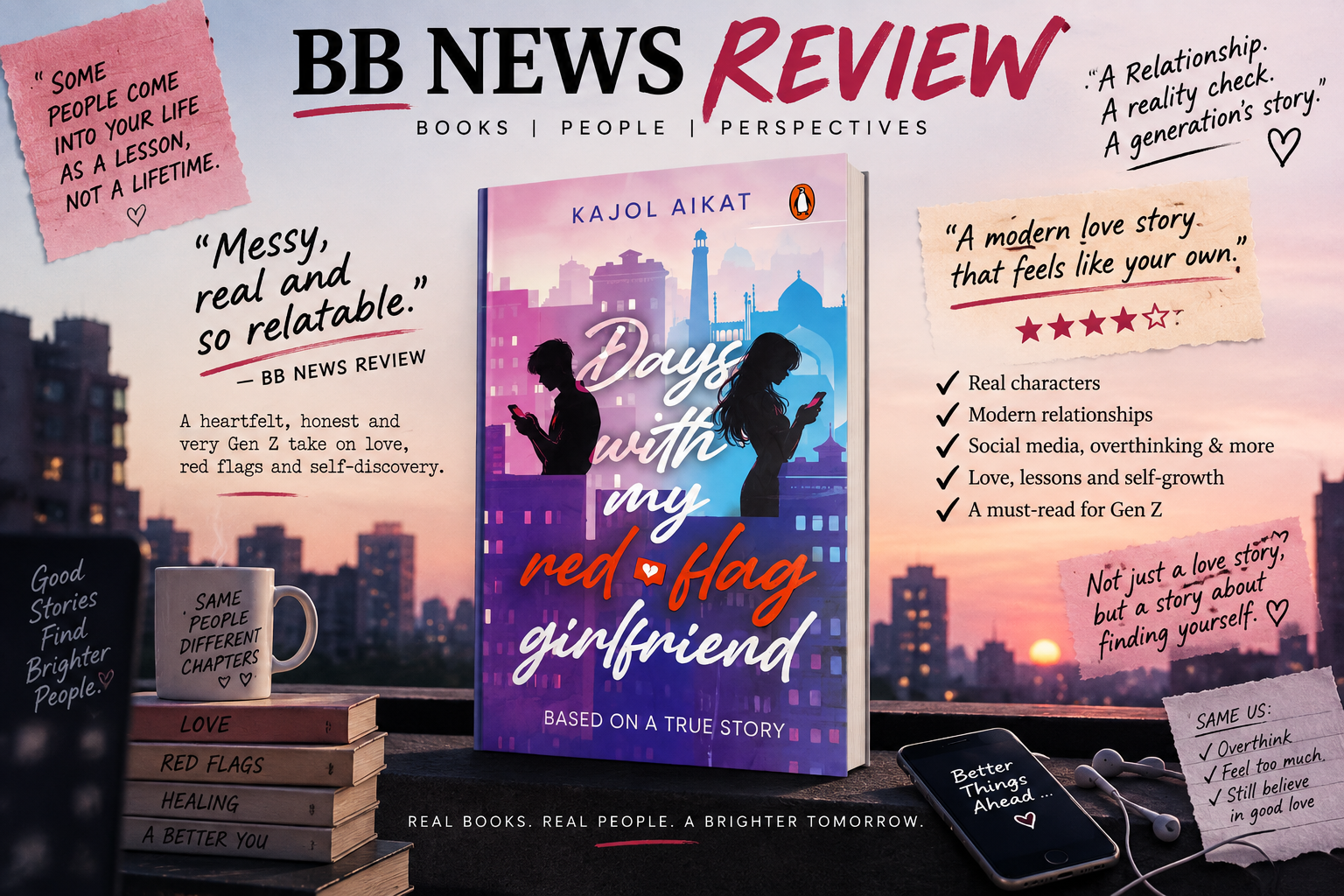
Book Review: Days with My Red-Flag Girlfriend by Kajol Aikat
Some books feel like stories. Some feel like someone has taken a very specific phase of your life, put it into words, and turned it into a book. Days with My Red-Flag Girlfriend by Kajol Aikat feels much closer to the second kind.
At first glance, the title makes you think this is going to be a straightforward story about a “toxic” or difficult girlfriend. But the book is actually much more than a list of red flags. It is about love, attachment, confusion, friendships, social media, insecurity, communication—and that very Gen Z habit of trying to understand relationships while we are still figuring ourselves out.
The story follows a relationship between the narrator and Tara, a girl who is unpredictable, complicated and, as the title suggests, carries quite a few red flags. But what makes the story interesting is that Tara is not written as a simple villain. She has her own insecurities, her own struggles and her own way of dealing with things. And the narrator isn’t exactly a perfect, emotionally mature person either.
That is probably one of the things I liked most about the book.
The relationship feels messy in a very real way.
There are moments of affection, jealousy, misunderstandings, arguments, awkward silences, overthinking and those tiny gestures that mean way more than they should. There are also plenty of situations that feel painfully familiar if you have ever been in a relationship where you didn’t know whether you were being understanding or simply ignoring the obvious.
And honestly, that is where the book feels very Gen Z.
The characters communicate through texts, DMs, Instagram, social media posts and little online interactions. There are references to reels, stories, notifications, Spotify, dating culture and the strange importance we sometimes give to someone’s online behaviour. The book understands that, for our generation, relationships don’t just exist when two people are physically together. They exist in the unread message, the changed profile picture, the story someone viewed, the post someone didn’t like and the text that suddenly ended with a full stop.
Sometimes, that digital side of relationships is more stressful than the actual relationship.
The writing is also very conversational. It doesn’t feel like the author is trying too hard to sound literary. Instead, the narration feels like someone sitting across from you and telling you what happened. There is humour, sarcasm, awkwardness and plenty of internal questioning. That makes the book quite easy to get into.
Another thing that stood out to me was how the story slowly moves beyond the idea of simply asking, “Who is the red flag?”
Because relationships are rarely that simple.
There are moments when Tara’s behaviour is frustrating and you genuinely want the narrator to walk away. But there are also moments where you understand why he stays. And then there are moments where you realise that love itself can make perfectly sensible people behave irrationally.
The book also explores how people carry their past into their present relationships. Family dynamics, old experiences, insecurity and the fear of losing someone can quietly influence the way people love. The chapter titled “Daddy Issues”, for instance, adds another layer to the characters instead of keeping the story limited to romance. Similarly, chapters such as “Safe Space” and “The Butterfly Effect” suggest that the story is interested in the emotional consequences of seemingly small moments.
And then there is the fact that the book is “based on a true story.”
That changes the way you look at some of the events. You start wondering how much of this really happened, how many of these conversations actually took place, and how many people might recognise themselves in these characters.
However, I wouldn’t say the book is perfect.
At times, the storytelling can feel repetitive, especially when the relationship repeatedly moves through the same cycle of closeness, misunderstanding, emotional distance and reconciliation. Some of the social-media references and conversational exchanges may also feel very specific to the period in which the book was written. But at the same time, that is also part of its charm—it captures a particular kind of young Indian urban relationship and the way people in that generation communicate.
What ultimately stayed with me was not the idea that Tara was a “red-flag girlfriend.” It was the much more uncomfortable question underneath it:
How often do we recognise someone’s red flags and still choose to stay because we are emotionally attached to them?
And maybe that’s why the book works.
Because most of us don’t fall in love with perfect people. We fall in love with complicated people, and sometimes we become complicated ourselves in the process.
Days with My Red-Flag Girlfriend is not a book that tries to teach you how to have the perfect relationship. Instead, it gives you a messy, modern, sometimes funny and sometimes uncomfortable look at what relationships can actually feel like.
It is relatable without pretending that everything is cute.
My verdict: If you enjoy contemporary Indian fiction, relationship stories, emotionally messy characters and very recognisable Gen Z situations, this is definitely a book worth picking up. It is especially likely to hit differently if you’ve ever found yourself staring at your phone, rereading a message, overthinking a conversation and wondering, “Am I overreacting, or is this actually a red flag?”
Because sometimes, the biggest red flag isn’t the person you’re dating.
Sometimes, it’s how badly you want the relationship to work.