
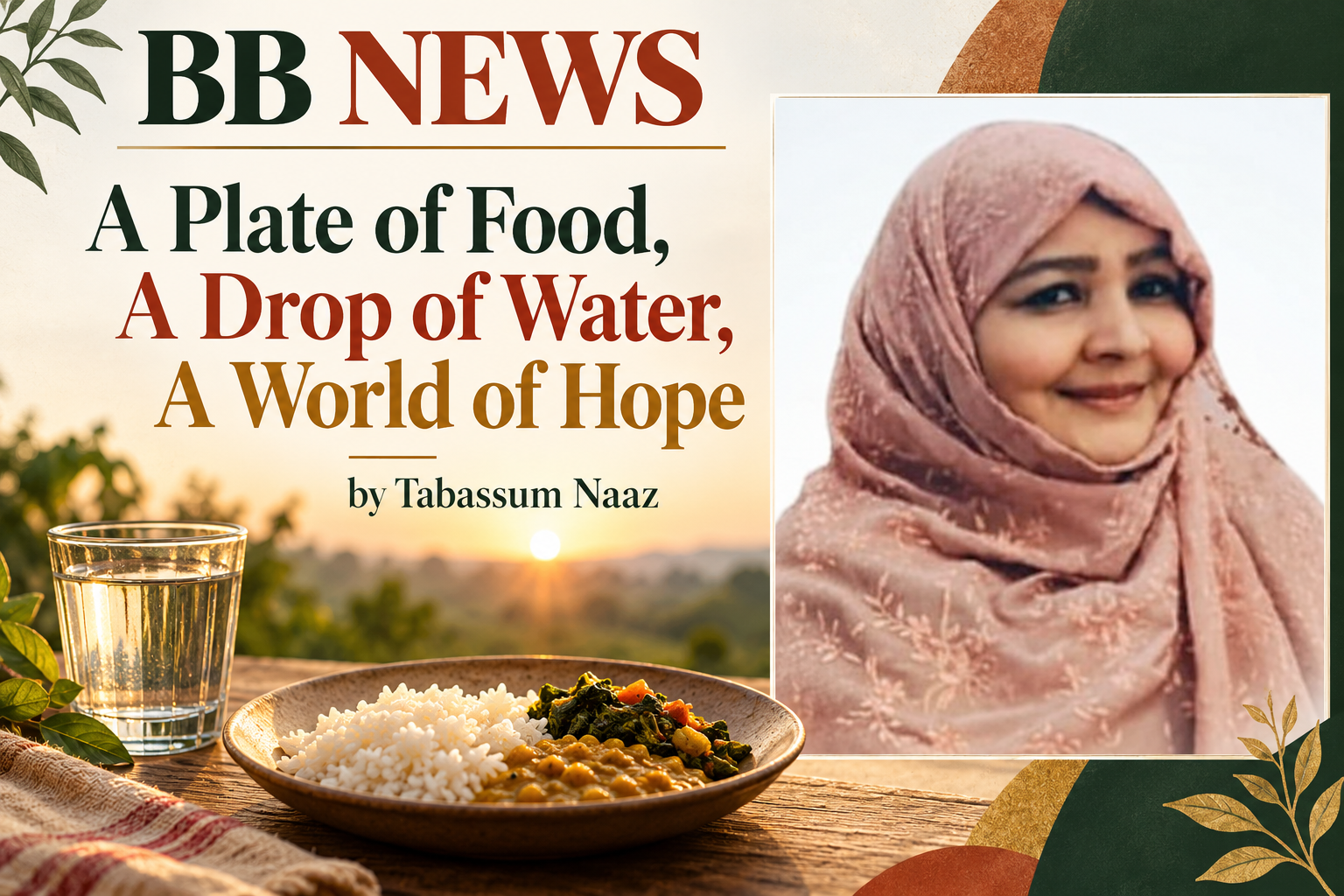
A Plate of Food, A Drop of Water, A World of Hope by Tabassum Naaz
“Sometimes, what we consider ordinary blessings are the very things someone else spends the day wishing for.”
Every day, we sit down to eat without giving much thought to the food on our plates. We drink water whenever we feel thirsty, and most of the time, we do not realise how fortunate we are. These things have become such a natural part of our lives that we hardly stop to appreciate them.
But somewhere, a child may be going to sleep on an empty stomach. Somewhere, a mother may be pretending that she is not hungry because there is only enough food for her children. Somewhere, a family may be walking a long distance just to find drinking water.
When I think about these situations, I cannot help wondering how something as essential as food and water can still be out of reach for so many people.
When Hunger Becomes a Daily Struggle
Hunger is not always visible. We may notice someone asking for food on the street, but we may never know about the families who quietly struggle behind closed doors. Some people are too embarrassed to ask for help. Others have become so used to managing with very little that they rarely speak about their difficulties.
For a child, hunger can mean sitting in a classroom without the energy to learn. For a working person, it can mean completing a tiring day without having eaten enough. For an elderly person living alone, it can mean missing a meal simply because there is nobody to help.
These situations make us realise that hunger is not just about an empty stomach. It affects health, education, confidence, and the simple joy of living without constant worry.
We often measure a country’s progress through its achievements, buildings, technology, and economic growth. These things matter, of course. But I feel that progress should also be measured by whether ordinary people can afford a proper meal and access safe drinking water.
What does development mean if some people have more food than they can eat while others do not know whether they will eat that day?
The Food We Throw Away
One thing that troubles me is the amount of food wasted in our everyday lives. At celebrations, weddings, restaurants, and even at home, food is sometimes thrown away because we have taken more than we need or prepared more than we can use.
We may not think much about the leftovers we discard. For us, it may be just a little food. For someone who has not eaten properly, that same food could have made a difference.
I believe we can begin by making small changes. We should take only as much as we can eat and take another serving if we are still hungry. We can plan our shopping better, store food carefully, and use leftovers safely.
At gatherings, organisers can work with reliable food-distribution groups to ensure that suitable surplus food reaches people who need it. Such efforts must always follow proper food-safety practices.
We do not have to wait for a special day or a campaign to start caring. We can practise these habits every day.
“A little food saved from waste can become a little hope in someone’s life.”
Every Drop of Water Matters
Food is important, but so is water. Without water, there can be no farming, no cooking, and no healthy life. Yet, many people still struggle to obtain clean drinking water.
Sometimes, we leave a tap running while doing other things. We ignore a leaking pipe or use more water than necessary. These actions may appear harmless, but repeated waste has consequences.
Saving water does not require a complicated plan. We can close taps properly, repair leaks, collect rainwater where possible, and avoid using more water than we need. Communities can also work towards protecting local water bodies and keeping them free from pollution.
Farmers need access to reliable water resources and practical methods of using water efficiently. Clean water and good sanitation must also be made accessible to vulnerable communities.
We should remember that water is not something to be taken for granted. It is a necessity that every human being deserves to have.
We Can All Do Something
Sometimes, when we hear about problems as large as hunger and poverty, we feel helpless. We wonder what one ordinary person can possibly do.
But perhaps we underestimate the value of small acts.
We can contribute to a community kitchen, support a trustworthy food-donation initiative, help a neighbour in need, or participate in a local awareness campaign. Even teaching children not to waste food is a meaningful beginning.
At the same time, we must understand that charity alone cannot eradicate hunger. People also need employment, fair opportunities, affordable nutritious food, and access to essential services. Governments, organisations, businesses, and communities must work together to address poverty, food insecurity, and the challenges that affect food production and distribution.
Most importantly, anyone receiving help should be treated with respect. Nobody should have to sacrifice their dignity to receive a meal or a glass of water.
Kindness should never make another person feel small.
Let Us Begin With Ourselves
For me, the message of the Eradicating Hunger 2026 campaign is simple: we must learn to value what we have and become more thoughtful about those who have less.
We may not be able to feed everyone, but we can help someone. We may not be able to solve the world’s water crisis, but we can stop wasting water in our own homes. We may not be able to change every situation, but we can refuse to remain indifferent.
Sometimes, we wait for a great opportunity to do something meaningful. We forget that an opportunity may already be sitting in front of us—in the extra food we can share, the water we can save, or the person we can help without expecting anything in return.
“Let us never forget the value of a full plate until every empty plate has found a reason to hope.”
A world without hunger may seem like a distant dream, but dreams become possible when people are willing to take responsibility. Let us be more careful with food, more respectful of water, and more sensitive to the struggles of others.
Tomorrow, when we sit down for a meal, let us take a moment to be grateful. And if we have the means to help someone else, let us not postpone that kindness.
After all, a better world will not be built by awareness alone. It will be built when awareness changes the way we live.
Let us make sure that food is not wasted, water is not taken for granted, and people in need are not forgotten.
Penned by TABASSUM NAAZ