
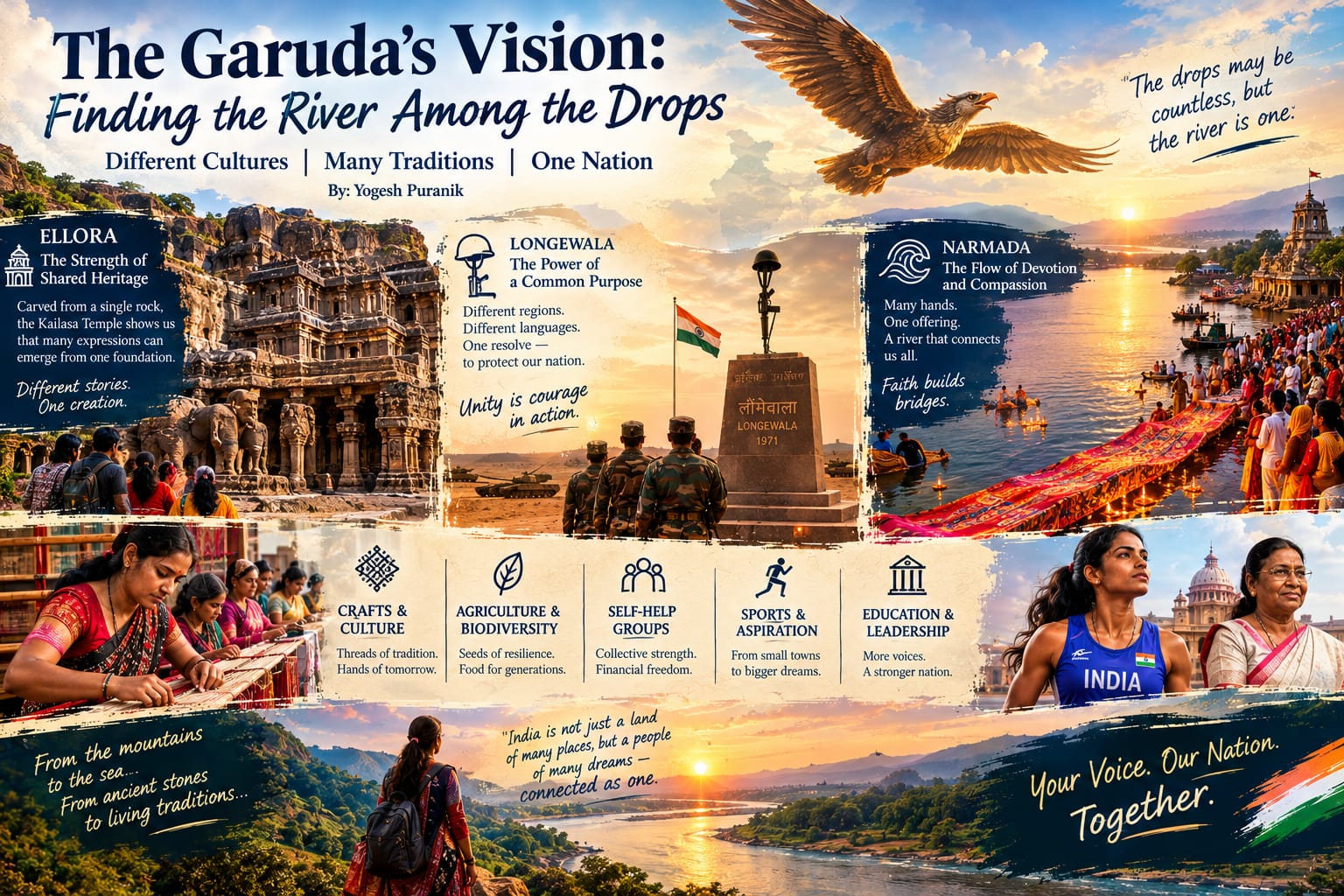
The Garuda’s Vision: Finding the River Among the Drops (Different Cultures | Many Traditions | One Nation) By: Yogesh Arvind Puranik
In the quiet sanctuary of a Gaushala, a profound lesson about human nature unfolds through the footsteps of a blind Gaumata. Unable to see her surroundings, she walks in circles, retracing familiar ground until a gentle nudge from the herd or a caretaker guides her towards a purposeful path.
Human society, too, can fall into such circles. We grow accustomed to our own languages, customs, and traditions until the familiar begins to seem universal. We mistake our pond for the entire ocean, forgetting the countless worlds beyond its banks. The danger lies not in loving our own culture, but in believing it is the only one that matters.
To transcend this narrow vision, we must learn to see as the mythical Garuda sees. From the heights, the Garuda witnesses a river’s journey from rugged mountains through fertile plains towards the boundless sea. What appears separate on the ground reveals its continuity from the sky.
Perhaps this is the vision India asks of us: to recognise that our unity does not depend upon sameness, but flourishes through diversity.
Our journey begins among the ancient Charanandri hills of Maharashtra, at the magnificent Kailasa Temple in Ellora. Carved from a single mass of basalt rock, this architectural marvel transforms stone into a world of intricate sculptures, imposing pillars, and sacred imagery. Its sculpted elephants appear to shoulder the temple itself, offering a powerful image of strength through collective support.
Each carving tells its own story, yet all belong to one extraordinary creation. Similarly, India’s languages, philosophies, artistic traditions, and customs possess distinct identities while drawing upon a shared civilisational inheritance. Their beauty lies not in becoming identical, but in enriching the whole while retaining their individuality.
To admire a single sculpture is to appreciate beauty. To behold the entire temple is to understand how countless expressions can emerge from a common foundation. Ellora reminds us that India’s diversity is not an obstacle to unity; it is among its greatest sources of strength.
From Ellora, the Garuda turns towards the shifting sands of Rajasthan, where the Longewala War Memorial commemorates a different expression of national unity.
During the night of 4–5 December 1971, Indian soldiers stationed at Longewala faced a formidable Pakistani armoured advance. Despite being heavily outnumbered, they held their position with extraordinary courage and determination, supported by the Indian Air Force.
Like the wider Indian Army they represented, these soldiers belonged to a nation of many languages, regions, and traditions. At Longewala, their individual backgrounds converged in a shared resolve to defend their country. Their unity was not an abstract ideal expressed in words. It was a commitment demonstrated through courage, sacrifice, and responsibility towards one another.
Longewala teaches us that national identity does not demand the abandonment of regional or cultural identities. Instead, it asks us to recognise that our differences exist within a larger bond of citizenship and shared responsibility. The nation is more than a boundary drawn on a map. It is a collective promise to protect a land and its people, including those we may never meet.
The Garuda now sweeps eastward into Madhya Pradesh, following the winding course of the Narmada. Revered as Maa Narmada, the river sustains countless lives while nurturing a rich tradition of faith and devotion.
During celebrations of Maa Narmada Jayanti, the sacred river becomes a meeting place for communities united by faith and devotion. As dusk falls, the evening Aarti illuminates the water with flickering lamps and prayers. Among the most evocative expressions of this devotion is the offering of an immense chunari, a vibrant expanse of fabric carried across the river, sometimes with the help of boats, to symbolically adorn the river goddess.
The image is simple, yet deeply moving. Such an offering is possible only through collective effort, with many people contributing to a shared act of devotion. Each hand plays its part, and the beauty of the offering emerges through their cooperation.
The chunari thus becomes a metaphor for India itself. Its colours retain their individuality, yet come together in a single offering. Like the threads of a tapestry, our languages, traditions, and cultural identities need not lose their distinctness to contribute to a greater whole. Their strength lies not in becoming identical, but in coming together with a shared sense of belonging.
This spirit of togetherness finds another expression in the Narmada Parikrama, the arduous pilgrimage undertaken by devotees along the sacred river. As pilgrims journey through unfamiliar villages and changing landscapes, they often depend upon the generosity of strangers. A meal offered to a weary traveller or shelter provided for the night becomes a language of compassion that transcends social and regional boundaries.
The river nourishes every field along its course without asking who owns the land. Likewise, a society grows stronger when kindness extends beyond the boundaries of familiarity. To see only one village along the Narmada is to know a fragment of its story; to follow its course is to discover the connections that bind its many shores.
Ellora reveals the strength of a shared cultural inheritance. Longewala demonstrates the power of a common purpose. The Narmada embodies the everyday bonds of faith, service, and compassion. Together, they remind us that unity is not the absence of differences, but the ability to find fellowship across them.
In a country as diverse as India, this understanding must extend beyond ceremonial celebrations into everyday life. It requires us to respect unfamiliar customs, listen to different perspectives, and recognise the dignity of every citizen. True national unity grows when curiosity replaces prejudice, understanding overcomes suspicion, and our commitment to one another remains stronger than the differences between us.
The call of Different Cultures | Many Traditions | One Nation is therefore an invitation to enlarge our vision. We must move beyond the comfortable circles of familiarity and discover India in its full complexity, with its many colours, histories, and aspirations.
Perhaps this is what the Garuda has been teaching us all along. From the ground, we see separate villages, distinct traditions, and distant shores. From the sky, we begin to recognise the river that connects them.
As evening descends upon the Narmada, countless lamps tremble upon its waters. Each flame burns with its own light, yet all travel upon the same flowing current. The river carries their reflections onwards, towards horizons none can see in full.
So must India move forward, with every culture preserving its light and every tradition contributing to the radiance of the whole. For a nation is not made stronger by asking its people to become alike, but by helping them discover what they can become together.
And somewhere above the mountains, the desert, and the river, the Garuda continues its flight, reminding us that the drops may be countless, but the river is one.
Your Voice. Our Nation. Together.