
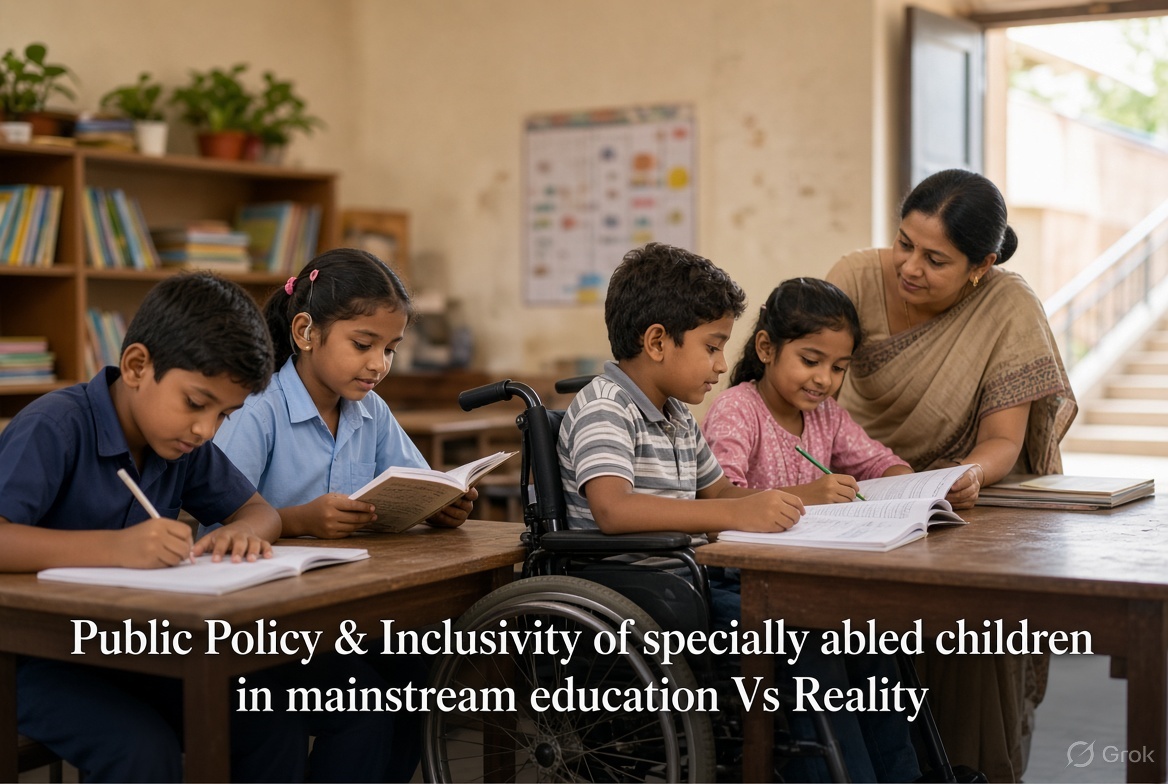
Public Policy & Inclusivity of specially abled children in mainstream education Vs Reality – Tulika Majumder
The promise on paper is clear. A child who learns differently, moves differently, hears differently, or sees the world through autism or cerebral palsy should sit in the same classroom as everyone else, with the supports that make that seat real. Public policy in many countries has said this for decades. The lived picture in mainstream schools is slower, patchier, and often kinder in the statute than in the staff room.
The modern idea took shape at Salamanca in Spain in 1994. Representatives of 92 governments and 25 international organisations agreed that ordinary schools should teach all children together wherever possible, and that separate systems should be the exception, not the default. UNESCO still treats that statement as the spark for inclusive education worldwide. The logic was practical as well as moral. A school that learns how to teach a child with a disability usually becomes a better school for everyone else. Three decades later the same agency reports that the gap between the slogan and the classroom remains wide. Around 40 percent of countries still do not train teachers on inclusion. Laws in about a quarter of countries still allow children with disabilities to be educated in separate settings, and that share rises above 40 percent in parts of Asia and Latin America. A 2024 regional review in Latin America found that 81 percent of students with disabilities are enrolled in regular schools, yet fewer than half of regular schools actually take them, and more than a third leave before finishing upper secondary school.
India built a stronger legal floor than many places. The Right of Children to Free and Compulsory Education Act, in force from 2010, says no school may refuse admission because of disability. The Rights of Persons with Disabilities Act of 2016 goes further. Section 16 requires institutions funded or recognised by government to provide inclusive education, to admit without discrimination, and to make buildings, campuses, and teaching accessible. Children with benchmark disabilities, defined as 40 percent or more of a specified disability, between the ages of six and eighteen have a right to free education in a neighbourhood school or a special school of their choice. The National Education Policy of 2020 endorses that framework and asks for a whole school approach: resource centres, special educators, teacher training, adapted materials, and room for arts, sport, and vocational work. The Central Board of Secondary Education has added exam concessions such as a scribe, extra time, flexible subject choices, and alternate questions. A screening tool called PRASHAST, developed by NCERT, is meant to catch disabilities earlier at school level. Chandigarh went a step further in July 2025 with its first Education Policy for Children with Special Needs, promising free education to 18 in government and aided schools, non discriminatory admission, a share of the weaker section quota, Braille and large print books, sign language resources, and trained special educators. Private schools were told they must admit and support these students too.
Courts have started to treat those lines as orders, not hopes. In September 2025 the Delhi High Court told GD Goenka Public School to readmit a girl with mild autism. She had entered in the 2021 session, was diagnosed later that year, and was effectively pushed out by early 2023 after the school did not arrange a shadow teacher once offline classes returned. A bench led by Chief Justice Devendra Kumar Upadhyaya called the school’s objections unfounded and said private recognised schools must provide reasonable accommodation. An expert committee had already said she could continue with a shadow teacher. The court ordered readmission in an age appropriate class within two weeks and asked the Directorate of Education to watch the return. The case matters because it closes a common escape hatch: the claim that only government schools carry the duty.
The numbers show why cases like that still arise. Unified District Information System for Education Plus data for 2024 to 2025 put children with special needs at roughly 2.1 million of India’s 247 million enrolled students, well under 1 percent, against a National Education Policy ambition near 5 percent. Enrolment this low cannot be explained by prevalence alone. It points to children never registered, quietly refused, or dropped after the first difficult term. Retention is weaker still beyond primary grades. Ramps exist on paper more often than in usable form. Toilets that a wheelchair can enter are still scarce. Special educators are too few, and general teachers often receive a short workshop rather than real practice. A parent who asks for a scribe or a quieter corner can be treated as a nuisance. Fees continue in some private schools even after the child has stopped attending, which is what happened in the Goenka matter until the court stepped in.
The United States offers a useful comparison because its main statute is older and its data are more complete. The Individuals with Disabilities Education Act requires education in the least restrictive environment, alongside peers without disabilities to the maximum extent appropriate. A Government Accountability Office review found that the number of students with disabilities spending at least 40 percent of the day in a general classroom rose 25 percent between the 2012 school year and 2023, with the biggest gain among those spending 80 percent or more of the day there. In 2020 to 2021, about 66 percent of students aged 6 to 21 served under the Act spent 80 percent or more of their time in general education. An Indiana University study of high school students found that those in high inclusion settings scored substantially higher in reading and mathematics than peers in low inclusion settings and were more likely to earn a standard diploma by passing the state assessment rather than a waiver. A separate district study found that a shift toward inclusion did not hurt short term test scores or attendance and was linked to higher ninth grade promotion and graduation. Meta analyses stretching over decades point the same way: more integrated placements tend to produce better academic and social results than separate ones. None of this means inclusion is automatic. Students with intellectual disabilities and multiple disabilities still spend far less time in general classrooms. Funding fights, shortage of aides, and uneven district will remain ordinary complaints.
What the real picture adds up to is a policy that has moved from charity to right, and a school system that has moved only part of the way. Where a law names reasonable accommodation, a court will sometimes enforce it, as Delhi did. Where a board checks ramps and toilets at affiliation, as CBSE began to do more strictly, buildings change faster than attitudes. Where teachers are trained and a child is not pulled out for every lesson, test scores and graduation can rise, as the American evidence suggests. Where none of that is funded, the child with mild autism is still asked to leave, the child who cannot climb stairs is still marked absent, and the official enrolment share stays under 1 percent in a country that has already written the right sentence into statute.
Inclusion is not a special room at the end of the corridor. It is the ordinary classroom redesigned so that one more child can stay. The statutes already say that. The remaining work is staffing, money, inspection, and the daily decision of a principal who would rather keep the child than manage the complaint.