
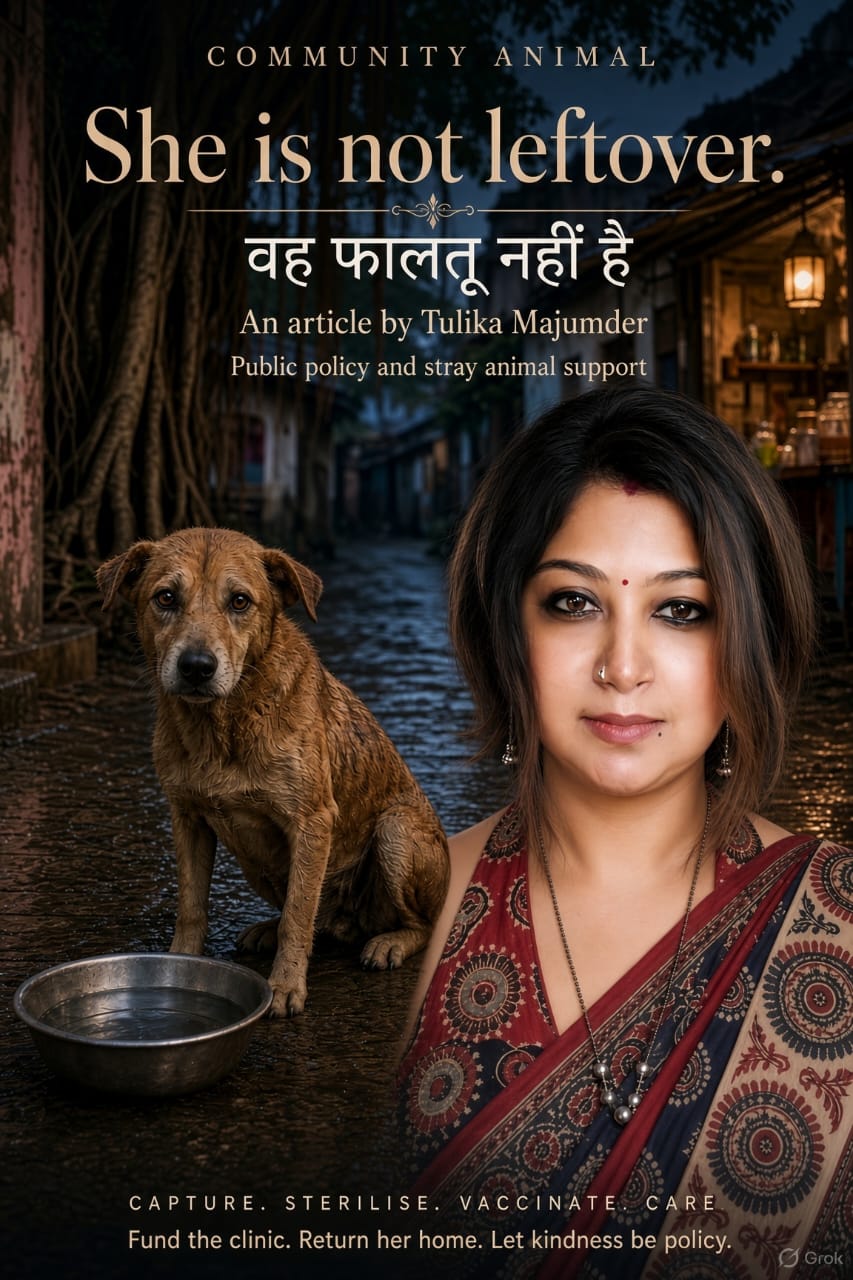
Public Policy and Animal Welfare Juxtaposition – by Tulika Majumder
Public policy on stray animals is at heart a test of whether a city can protect people without discarding the animals who already share its streets. Free roaming dogs and cats are not refuse. They are sentient beings who feel hunger fear pain and attachment. A humane policy therefore begins with that fact and then asks how public health and animal welfare can be pursued together rather than as enemies.
The most credible scientific path is still capture sterilisation vaccination and return to the same locality. This method treats the animal as a neighbour who will remain in the community after surgery rather than as an object to be erased. Antirabies vaccination protects both the dog and the people around it. Waste control reduces the scramble for food that brings animals into dangerous conflict with traffic and crowded markets. Targeted shelters should exist for the injured the sick the abandoned puppy and the animal who cannot safely live on the street.
India already possesses a welfare first legal architecture. The Prevention of Cruelty to Animals Act 1960 forbids unnecessary pain and suffering. The Animal Birth Control Rules 2023 place the duty of care on local authorities and replace older dog rules with a capture sterilise vaccinate and release model. Street dogs are to be caught humanely ear notched after surgery and returned to the place they know. The rules speak of community animals not of vermin. They ask resident associations and local bodies to form committees so that feeding can be organised with dignity instead of being driven into secret corners.
The gap is not the absence of compassion in the statute book. The gap is the failure to fund it. Across much of the country ABC centres remain few kennels few surgeons few transport vans and records too thin to prove that seventy percent coverage has been reached.
Judicial intervention between 2025 and 2026 made this tension visible to the whole country. After reports of bite incidents the Supreme Court of India tightened oversight of municipal practice. A brief turn toward holding collected dogs and refusing their return was later eased by a larger bench which restored the release of sterilised vaccinated and dewormed dogs to their original localities. The Court still carved exceptions for animals who are rabid suspected to be rabid or clearly aggressive and it asked cities to create dedicated feeding spaces in each ward so that care need not happen in the middle of a carriageway. Later directions required dogs found inside schools hospitals sports complexes bus stands and railway stations to be moved to shelters after sterilisation and vaccination and not sent back into those same sensitive premises. States were told to open at least one working ABC centre in every district and to keep antirabies vaccines available. Euthanasia was not opened as a general instrument of population control. It was confined to confirmed rabies incurable illness or demonstrably dangerous animals after veterinary assessment.
A welfare leaning reading of these orders is possible and necessary. Feeding zones can be a gift to animals if they are shaded watered and stocked rather than a pretext to criminalise kindness. Institutional premises can be made safer for children and patients without pretending that every community dog in a city of millions can be warehoused.
The public argument in India is often framed as caregivers versus parents. That framing is too crude. Most people want children to walk to school without fear and also do not want to see a familiar street dog starved beaten or dumped far from home. The welfare task is to make the 2023 rules real in every district so that compassion is not left to unpaid volunteers alone.
Abroad the same moral choice appears in different legal clothes. The Netherlands is often named as the first country to bring street dog numbers close to zero. It did so not by celebrating disappearance but by making abandonment costly and adoption ordinary. Capture neuter vaccinate and return or rehoming sat beside prison terms and heavy fines for cruelty. The Dutch result is a reminder that the kindest city is the one that prevents homelessness before it starts.
The United Kingdom gives local authorities a duty to collect a stray dog check for identification and search for an owner. If no owner is found the animal is typically moved toward a shelter whose purpose is rehoming rather than disappearance. Euthanasia remains legally available after a holding period yet in practice it has fallen sharply over recent decades and is concentrated on animals who are severely ill or cannot be placed safely.
Italy chose a no kill path for dogs and cats in national law in 1991. Feral cat colonies may be recognised and caretakers registered. A dog is not to be killed merely for being homeless. That legal promise is a moral advance. It also warns that a ban on killing without enough homes and without thorough sterilisation can leave animals for years in crowded kennels. Welfare is not only the refusal to kill. It is the duty to give a decent life after the refusal.
In the United States practice changes from county to county. Open admission shelters still receive large numbers of stray and surrendered dogs. For free roaming cats trap neuter return has been taken up by many cities and national welfare groups as a way to reduce killing while allowing colony caregivers to keep feeding and watching over animals they already know. Where intake exceeds loving homes the system still ends lives.
Turkey shows how quickly the moral baseline can shift. After years in which street animals were a visible part of urban life a 2024 law pushed municipalities to gather large numbers of dogs into shelters and allowed euthanasia for sick aggressive or unadoptable animals. Welfare groups condemned the turn as a retreat from coexistence.
The lessons that serve animals as well as people are not mysterious. Sterilisation must be continuous and wide enough to reach the breeding population. Feeding should be planned so that animals eat without being chased. Waste should be closed so that hunger does not become a riot at a dump. Shelters should be hospitals and bridges to homes not warehouses. Abandoned pets should be treated as a failure of human responsibility. Inspectors vans surgeons and public trust are the real instruments of kindness.
A public policy worthy of a civilised city protects children from rabies and attack and still refuses to manage animals through cruelty. It honours the person who puts down a bowl at a designated spot. It funds the clinic that returns a sterilised vaccinated dog to the lane she already guards. It punishes the owner who dumps a pet when the novelty fades. India already wrote much of this into the 1960 Act and the 2023 rules. The Netherlands the United Kingdom Italy the United States and Turkey show how those tools can end in a street without homeless dogs or in a pound that is only a slower form of exile. The difference is whether the state stays with the animal for years after the headline fades.