
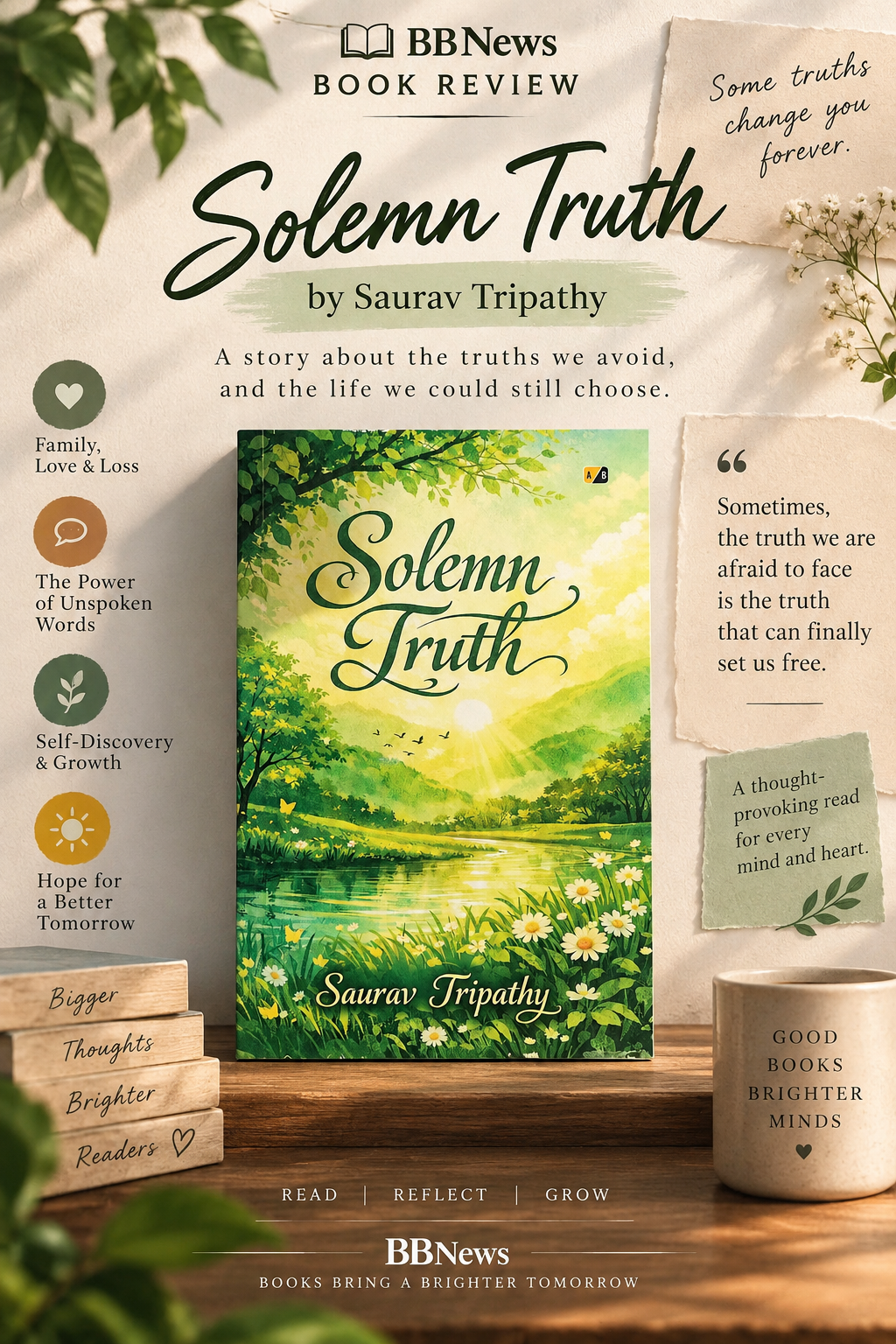
Solemn Truth by Saurav Tripathy
Solemn Truth by Saurav Tripathy is a thoughtful and emotional book about life, relationships, family, silence, regret, and the things we often leave unsaid. It is not a story that depends on big twists or dramatic events. Instead, it focuses on the small moments in life that slowly change a person and make us think about our own choices.
The story mainly follows Arun, a man who carries many thoughts, questions, memories, and regrets within himself. He is not shown as a perfect person. He makes mistakes, struggles with his decisions, and sometimes finds it difficult to say what he really feels. This makes him feel real and relatable. His journey is less about becoming a completely different person and more about understanding himself and facing the truth he has avoided for a long time.
One of the strongest parts of the book is its focus on silence. Many important things in the story are not said at the right time. People make assumptions, hide their feelings, avoid difficult conversations, or simply wait for the “right moment” to speak. But sometimes that moment never comes. The book shows how the things we do not say can stay with us for years.
The different sections of the book add to this idea. Chapters such as “The Unopened Letter,” “The Boy Who Felt Too Much,” “The Question He Never Asked,” “The Silent Wars,” and “The Mother He Couldn’t Save” explore different parts of Arun’s life and personality. Each section gives us another piece of his story. As we move forward, we understand that his present life is closely connected to his past.
The chapter “The Boy Who Felt Too Much” particularly brings out the emotional side of Arun. He is someone who feels deeply, but being sensitive is not always easy. Sometimes people who feel the most are also the ones who find it hardest to explain what is happening inside them. This part of the story makes Arun more human because his struggles are not always visible to the people around him.
The book also gives importance to family and especially the relationship between a child and a parent. The sections dealing with Arun’s mother carry a lot of emotional weight. There is love, responsibility, helplessness, and regret. The idea behind “The Mother He Couldn’t Save” is painful because it reminds us that love does not always mean we can save someone from every difficult situation. Sometimes, what remains after loss are the memories and the things we wish we had said.
Another important part of the book is “The Choice To Stay Small.” This idea can connect with many readers. Sometimes we choose a smaller, safer life because we are afraid of failure, change, responsibility, or disappointment. We may have dreams but still keep ourselves from chasing them. The book makes us think about whether we are truly happy with our choices or simply comfortable with them.
I also liked the way the book deals with work, purpose, and personal growth. Arun’s journey is not only about his relationships. It is also about understanding what he wants from his life. The section “The Plan He Finally Wrote” shows the importance of finally taking action instead of endlessly thinking about what could be done. Planning one’s life may not solve everything, but it can be the first step towards change.
The student-teacher relationship in the story also adds another interesting layer. The idea of “The Student Who Saw Through Him” shows that sometimes another person can notice things about us that we try very hard to hide. We may think we are successfully hiding our fears and weaknesses, but someone who observes us carefully can see through that mask.
One of the most meaningful sections is “The Conversation That Never Happened.” This title itself captures one of the main messages of the book. There are conversations we keep postponing because they are uncomfortable. We tell ourselves that we will talk tomorrow, next week, or when things are better. But life does not always give us another chance. This part of the story makes the reader think about the conversations they may have avoided in their own lives.
The letter is another important element of the book. It works as more than just a physical object. It represents truth, memory, emotions, and words that have been waiting to be understood. The movement from “The Unopened Letter” to “The Letter Opened” gives the story a strong sense of completion. At the beginning, there is something that remains unopened and unknown. By the end, there is a willingness to face what has been hidden.
I also found the screenplay-like presentation interesting. The use of scenes, locations, timelines, conversations, notebook entries, and directions such as FADE IN, CUT TO, and FADE OUT makes the book feel visual. While reading, it is easy to imagine the scenes taking place like a film. This is one of the book’s unique features and could also make the story interesting for readers who enjoy visual storytelling.
At the same time, the changing timelines and scenes may require a little attention from the reader. The book is not something I would recommend rushing through. It works better when read slowly because many of its important ideas are hidden in conversations, memories, and quiet moments rather than in major events.
What makes Solemn Truth special is that it does not try to give easy answers to difficult questions. Instead, it makes us ask our own questions. Are we honest with the people we love? Are we saying what we really feel? Are we making our own choices, or are we simply doing what others expect from us? And most importantly, what happens when we keep postponing the truth?
The writing is emotional without being unnecessarily complicated. The conversations are simple, but many of them carry deeper meaning. The book talks about sadness, family, loneliness, responsibility, relationships, failure, grief, and hope in a way that feels personal.
Overall, Solemn Truth by Saurav Tripathy is a reflective and emotional read. It is a book about the truths we avoid, the questions we never ask, and the conversations we keep delaying. Arun’s journey reminds us that growing up is not only about achieving things. It is also about accepting our mistakes, understanding our emotions, facing our past, and finding the courage to speak.
The book leaves the reader with a simple but powerful thought: sometimes, the truth we are afraid to face is the truth that can finally set us free.